When heatmaps stop being enough
Heatmaps and spaghetti charts answer where time went. They stop being enough when the plant still cannot say which demand produced each move, who accepted it, and which route that order took.
What Step 01 can settle, and what it cannot
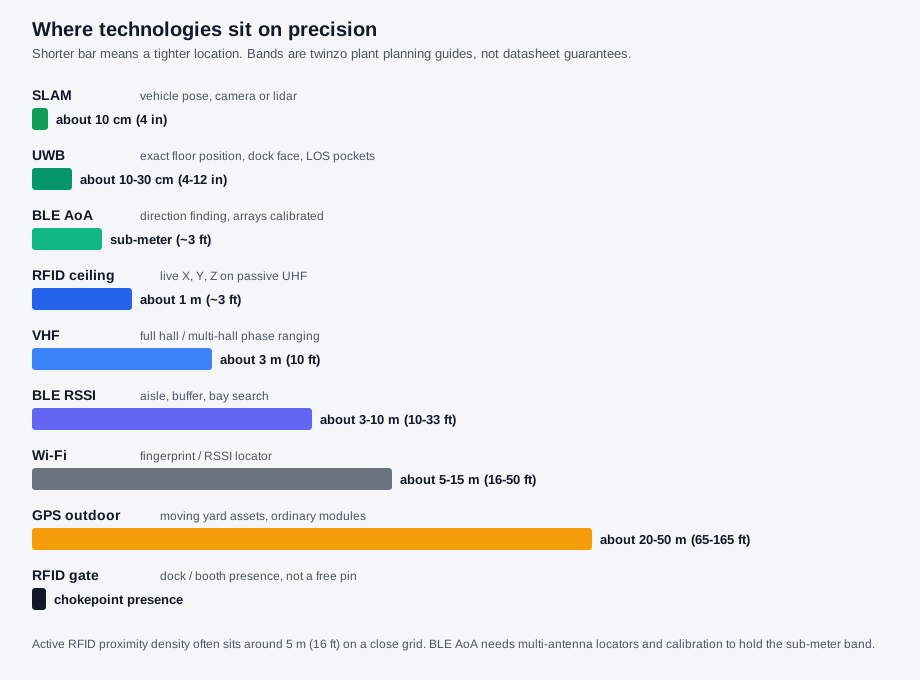
Position analytics on a live facility map settles correlation questions. It shows which aisles run hot, which buffers accumulate dwell, and which shifts show unbalanced fleet load. A real-time location system (RTLS) feed at medium precision around 1–3 m (3–10 ft) is usually enough for that internal logistics work. The milestone is defined under position analytics is the first milestone that pays on the floor.
Those charts do not settle causality. A bright corridor can mean healthy throughput or repeated empty travel loops chasing radio calls. A free truck beside a starve can be coincidence until the record shows whether a material call-off existed, whether anyone accepted it, and how long the path took. Without order context, continuous improvement still argues from pictures instead of from linked demand and moves.
Signals that the gate has arrived
The plant is ready to leave heatmap-only work when three conditions hold at once. First, supervisors already act from the shared live facility map for search and load questions, so location is trusted enough to attach process rules. Second, a spatially oriented dataset of closed shifts exists, so later pattern work will not start from a blank week. Third, the remaining waste is purpose and timing of moves, not ignorance of where tagged objects sat.
Industry practice on lean logistics under Industry 4.0 keeps the same sequence: make transport and waiting measurable before you automate or orchestrate them. Automating chaotic push copies muda into CapEx. Visibility before automation for that decision sits under lean logistics under Industry 4.0 is visibility before automation. The twinzo path treats logistics orchestration as Step 02 after correlation, in five steps from correlation to the operational digital twin.
What orchestration must add at the gate
Crossing the gate means every move starts to carry purpose. A button, scan, tablet, or MES signal creates a claimable work order. A driver accepts in a group broadcast pool. twinzo names that loop AOS. Industry catalogs usually say forklift guidance system (FGS). Acceptance locks requester, acceptor, place, and time. The path while the task is open joins the same shared live facility map.
That is the base for causality on the journey. Location history alone shows co-occurrence. Order-linked history shows which demand and which acceptance preceded the wait. How the call starts that record is covered in the call that starts the record. The Journey milestone page is logistics orchestration turns location into causality.
What is not a reason to cross yet
Do not fund orchestration because the heatmap looks finished in a vendor meeting. Do not fund it because an AI roadmap needs "more data" without naming which fields will join location. Do not fund it as a substitute for fixing accuracy that the shift already rejects. If the map and the floor disagree, stay on Step 01 until they agree. If nobody will open the map on a busy hour, a work-order pool will not create trust by itself.
Also separate orchestration from outdoor scale and from AI analytics. Yard GPS continuity is Step 03. Automatic actual-versus-optimal comparison is Step 04. Both reuse order-linked indoor moves. Neither replaces the gate test for Step 02. Jumping to AI before place-and-time context exists is the failure mode in AI roadmaps arrive before a place-and-time dataset exists.
How teams decide without stalling
1. Write the missing question - If the open question is still "where did time go," stay on position analytics. If it is "why did that move happen and who owned it," cross the gate.
2. Require one waste owner for pull - Logistics or production must own response time and logistics-caused idle time before AOS / FGS rollouts multiply across corridors. Ownership before the tech catalog is the related lean gate under digital lean needs a waste owner before the tech catalog.
3. Keep Step 01 paying - Search, utilization, and dwell stay daily work after pull starts. That additive rule is covered in each early layer must still earn money when the next one lands.
4. Prove on a bounded corridor - One line family, one driver group, clear pass metrics for acceptance latency and empty travel, then expand. Product entry points are material order automation and internal logistics optimization.
Get in touch if you want to test whether your plant is still in heatmap territory or ready for order-linked moves on the same facility model.