Five steps from correlation to the operational digital twin
The path to an operational digital twin is five additive steps, not one CapEx line item. Each step pays on the floor and stores the place-and-time record the next step needs.
Why the journey is staged
Industry 4.0 maturity models such as the acatech Industrie 4.0 Maturity Index treat progress as ordered capability: connectivity and visibility before transparency, then predictive capacity, then adaptability. Published digital-twin maturity work repeats the same order. Live monitoring and a trustworthy record come before forecasts and autonomous action. Plants that jump to AI or a finished whole-plant twin pitch without that record stall, which is why the twinzo path starts with movement you can see and ends with cross-domain questions on one spatial model.
The journey does not start from a blank plant. Most sites already run ERP, MES, WMS, and SCADA that still refuse to share place and time. That baseline and the first bounded pilot are covered in the starting point is still a collection of disconnected systems. Hosting often begins in public cloud and hardens later, as explained in cloud is the default starting point.
Step 01. Position analytics (correlation)
A real-time location system (RTLS) feed, or location data the plant already owns, places forklifts, people, and material on a live 3D facility model. Heatmaps, spaghetti diagrams, and fleet utilization show where time goes. Medium precision around 1–3 m (3–10 ft) is usually enough for aisle and buffer logistics. Exact floor position below about 30 cm (below 12 in) is a different job. Coarse zone presence answers wing or gate questions only.
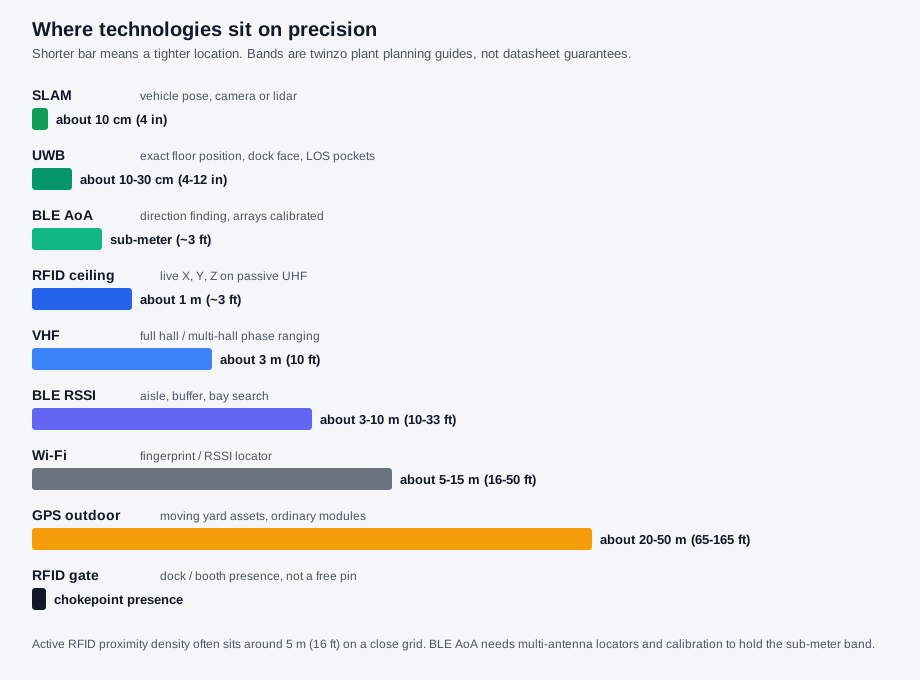
What this step adds is a spatially oriented dataset: where and when things happen, and how those places relate. That is the basis for correlation. Live search and fleet load pay off this quarter. The stored record pays off later when continuous improvement reads the same place-and-time history. For the milestone detail, see position analytics is the first milestone that pays on the floor.
Step 02. Logistics orchestration (causality)
Logistics switches from push schedules and radio callouts toward pull. A button, scan, tablet, or MES signal creates a work order. A free driver accepts the work in the same class of system plants call a forklift guidance system (FGS). twinzo names that layer AOS. Every trip links to its order: who needed what, who accepted, when, which route, how long.
That order context is the base for causality. Location alone can show that a mover sat beside a starving line. Orchestration shows whether the move had a purpose and which call produced the wait. The readiness gate is explained in when heatmaps stop being enough. The same decision is spelled out in logistics orchestration turns location into causality.
Step 03. End-to-end logistics (scale)
The same visibility extends beyond one hall: yards, docks, warehouses, and partner sites on one twin. Outdoor GPS hands over to indoor RTLS so the same truck or rack stays visible from the supplier yard to the line. Gaps between sites become measurable. Analysis can then see causes that start outside the plant gate, which is ordinary smart manufacturing practice once indoor material pull already works.
Scale is a journey decision, not a second disconnected RTLS buy. Continuity rules are covered in indoor-outdoor handoff is a scale choice, not a second RTLS project. When the journey should leave the single hall is covered in end-to-end logistics: when the journey leaves the single hall.
Step 04. AI for intralogistics (AI analytics)
AI and machine learning run on the spatial record to find correlations and causal relationships automatically instead of only by hand. Useful targets are idle time, empty travel, and waiting at the line. Live comparison of actual versus optimal flow points to deviations the shift can act on now, not only after the meeting.
That layer waits on order-linked moves and a dense enough history. Buying or training models before place, time, and labels exist is a common smart factory failure mode covered in AI roadmaps arrive before a place-and-time dataset exists. The journey gate is explained in AI for intralogistics only after moves carry order context. What Step 04 unlocks is covered in actual vs optimal flow: what the AI analytics milestone unlocks.
Step 05. Operational digital twin (the whole plant, live)
The destination overlays logistics, production, quality, and energy data from MES, WMS, ERP, SCADA, and industrial protocols on one shared 3D model of the plant. Cross-silo questions become answerable because events share place and time. The stored spatial history remains the base for later predictive operations. A full predictive twin still waits on that dense record, as covered in predictive digital twins wait on stored history.
Live internal logistics, the spatially oriented dataset, and correlation and causality analytics stay equal reasons to keep the twin honest at every earlier step. Nothing built in Steps 01–04 gets thrown away when Step 05 lands. That compounding rule is covered in each early layer must still earn money when the next one lands. What arrival looks like on the floor is covered in cross-domain questions on one spatial model: arriving at the operational twin.
How teams use the map without stalling
1. Name your current step honestly - Heatmaps without order-linked moves are still Step 01. Pull without outdoor continuity is still Step 02. AI roadmaps without a spatial record are not Step 04 yet.
2. Prove value before you expand scope - A two-to-four-week zone pilot, then a one-to-three-month facility rollout, remains the usual prove path. Do not buy Step 05 language for a Step 01 budget.
3. Keep every layer additive - Position feeds orchestration. Orchestration history feeds AI. Hall success feeds end-to-end scale. The twinzo umbrella for internal logistics optimization, material order automation, and production monitoring is built to ingest that stack without rip-and-replace.
Get in touch if you want to place your plant on this five-step map and decide which milestone should pay next.