Position analytics is the first milestone that pays on the floor
Position analytics is the first milestone on the Industry 4.0 digital twin journey that returns value on the floor. You see where everything moves before you ask why every move happened or what AI should change next.
What position analytics is
A real-time location system (RTLS) tag set, or location data the plant already owns, places forklifts, people, and material on a live 3D model of the hall. The shift opens one shared facility map instead of guessing from radio traffic and end-of-shift memory. Reports compare shifts, drivers, and vehicles. Heatmaps and spaghetti diagrams show which corridors and buffers absorb time.
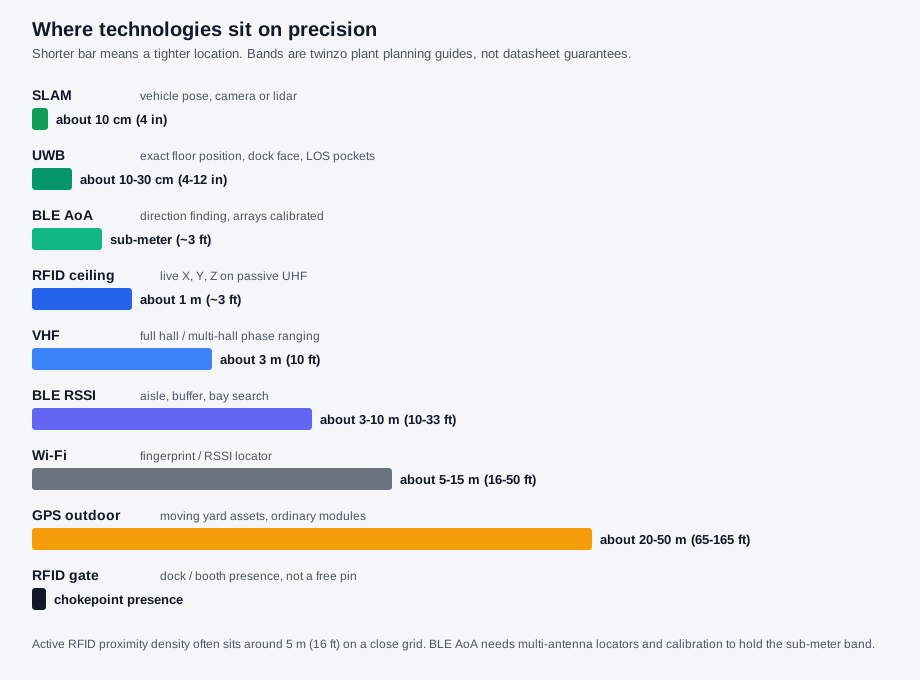
That picture is asset tracking and forklift tracking in operations language, not a separate analytics product. Medium precision around 1–3 m (3–10 ft) usually covers aisle search, fleet load, and buffer dwell. Coarse zone presence answers which wing or gate holds the tagged asset. Exact floor position below about 30 cm (below 12 in) is a different buy when the mark itself matters. Matching accuracy to the job is settled under start with the decision, not the technology.
What it adds to the Industry 4.0 path
Industry maturity language calls this visibility: a digital shadow of what is happening now so decisions rest on measured place and time. twinzo names the stored form a spatially oriented dataset. Positions, dwell, and simple state accumulate under the live view. That record is the basis for correlation work. Later analysis on it can show which events share a bay and which empty loops keep preceding a wait.
Live internal logistics search, the stored spatial history, and later correlation and causality analytics are equal reasons to run this milestone. A map that never stores events has not finished Step 01. The full five-step sequence is covered in five steps from correlation to the operational digital twin. The disconnected systems baseline that usually precedes this work is covered in the starting point is still a collection of disconnected systems.
What "done" looks like for Step 01
1. Accuracy matches the decision - Medium precision for aisle and fleet work. Exact floor position only where the mark matters. Do not buy sub-meter accuracy for bay balancing.
2. Someone acts from the shared view - Supervisors no longer need to walk the floor just to answer basic where-is questions. Drivers and leads open the same hall map the morning review uses.
3. History is stored on purpose - Closed shifts leave trails for replay, utilization, and dwell. Pattern questions can start without rebuilding the afternoon from memory.
4. Scope stayed bounded long enough to learn - A two-to-four-week zone pilot with a clear pass line is the usual window to prove value before a one-to-three-month facility rollout. What that learning window usually costs is covered in what a two-to-four-week hall pilot actually costs to learn.
What position analytics does not finish
Seeing moves is not the same as giving every move a purpose. Without a clear demand signal and an accepted move for each trip, travel can still be radio-dispatched push work with a prettier chart. Causality needs order context: who needed what, who accepted, which route. That is Step 02, covered in logistics orchestration turns location into causality. The gate between the two milestones is when heatmaps stop being enough.
Position analytics also does not replace systems of record. MES, WMS, and ERP still own transactions. The spatial layer sits on top and fills the place-and-time gap those packages leave open. That additive rule is why early layers must keep paying when later layers land, under each early layer must still earn money when the next one lands.
How teams fund Step 01 without buying Step 05
Price the milestone as visibility plus a growing spatial record, not as a finished operational digital twin of every domain. Pass lines that finance can check are concrete: search time for tagged movers, utilization by shift, dwell at named buffers, empty versus loaded kilometres (miles) once load state is known. Why RTLS programs usually begin in logistics rather than in every machine cell is covered in why RTLS projects usually start with logistics.
twinzo puts that position feed on the same live hall model used for internal logistics optimization and production monitoring. Capability depth is listed on the features overview. Get in touch if you want to define the first zone, accuracy band, and pass line for position analytics on your facility model.