Models lived offline, not on the floor
Before continuous live positioning was practical in most plants, industrial AI stayed on models that never left the conference room or the simulation server. The shift still ran without those models on the floor.
What sat offline while the shift ran elsewhere
Static digital twins came from CAD files, scans, and BIM. Simulation digital twins dropped those models into physics or discrete-event simulation engines to run what-if layout changes. Data platforms tried to organize MES, ERP, and sensor streams into digital threads. Vendor materials often layered predictive AI claims on top of those CAD, simulation, and thread stacks without a continuous location stream to test them against.
What was missing was the continuous, spatially accurate location of movers and material on the floor: forklifts, people, and goods in transit. Without that stream, models and AI claims had no persistent ground truth on the hall to check against. Live real-time location system (RTLS) coverage of the kind that later became central to operational digital twins was still maturing. BLE and UWB were not yet everyday fixtures on most factory floors. How those twin types split today is covered in not every digital twin is the same.
Simulation could plan, but not watch the shift
Simulation tools answered useful questions before a change was made. They could not show the actual spaghetti of routes taken on a given shift. Without location updates arriving every few seconds, there was no continuous record of where a pallet sat, how long a driver waited, or which aisle three forklifts occupied at the same moment a line stopped.
Plant teams evaluating those earlier systems usually received dashboards of aggregated KPIs and OEE values fed from the MES. The spatial context that would later let someone see a micro-stop next to a forklift path on a three-dimensional hall map was still uncommon. Talk of causality between logistics gates, HVAC loads, and quality remained conceptual. Correlation required the where and the when of every movement, and that data was not present at scale. Why organizing streams alone was not enough is covered in organizing the streams came first.
Digital threads stopped at the abstract
Many solutions organized heterogeneous streams into digital threads. They ingested PLC data, production counts, and quality events. Without a live map of physical locations, the thread stayed abstract. An engineer could see that a line had stopped. They could not immediately see where that stop was relative to movers, buffers, or emptied bays on the same hall.
Positioning technologies had to become reliable enough and inexpensive enough for everyday floor use before an operational layer could close the gap between model and reality. Until then the AI pitch stayed one step removed from the physical movement of goods and people. Even when production-logistics twin write-ups treat bidirectional connection to enterprise systems as necessary, continuous spatial state remains a separate hard requirement. A table of events is not the same object as a hall with locations.
How the missing locations shaped the language
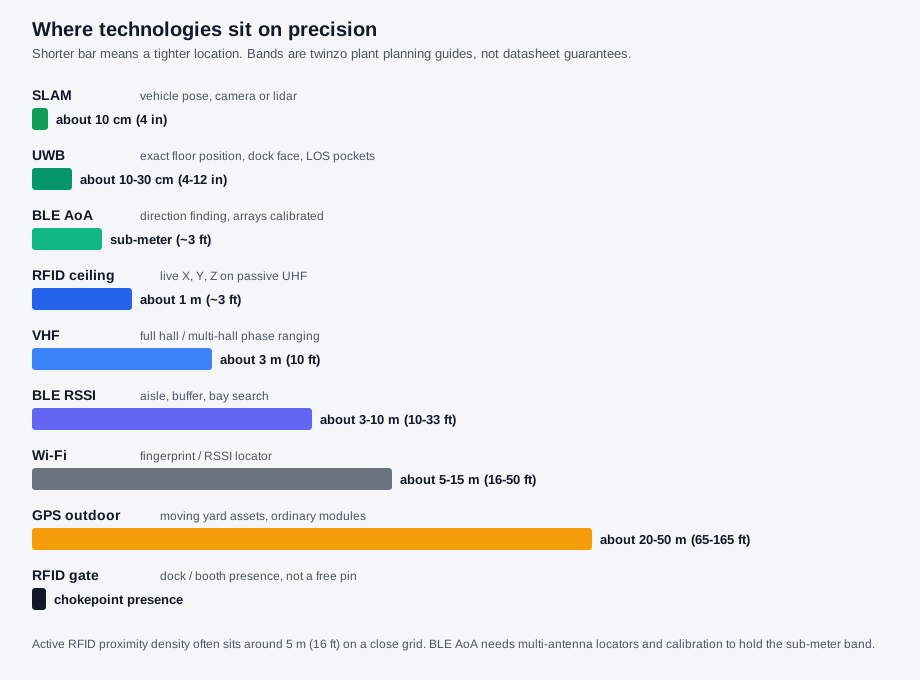
Sales language in that earlier period leaned on future closed-loop digital twin architectures and AI that would eventually detect root causes automatically. The concrete mechanism, continuous three-dimensional locations of the movers and material that matter for the shift, was still emerging. Accuracy ranges that later became familiar were not yet baseline assumptions in most plants: BLE typically delivers medium precision around 1–3 m (3–10 ft) for aisle and bay work, while UWB often reaches sub-meter (~3 ft) when the job needs exact floor position. The ability to replay a full year of locations was not a standard feature buyers expected.
As a result, many AI-in-manufacturing presentations remained high-level: optimize flows, cut idle time, respond faster when a line stops. The continuous location capture that later turned those phrases into measurable route analytics, spaghetti diagrams, and shift-level movement reports had to exist in the plant first. Vendors were pitching the end state of automated optimization while continuous location infrastructure was still missing from most halls.
What that history implies for buys today
Once continuous locations are available, keep three equal jobs in view. Live internal logistics uses the map on this shift, the spatially oriented dataset under that view is the reality replica later models need, and correlation and causality analytics use the same history for hall-wide pattern work. Prediction remains a later use of a dense operational record, as in predictive digital twins wait on stored history.
twinzo ships the operational digital twin that puts live locations and plant signals on a hall people trust. That layer supports internal logistics optimization and production monitoring now, and stores the place-and-time record AI work still waits on. Capability detail lives on the features overview. Get in touch if you want to walk through how continuous locations change what offline models could never show.