Indoor-outdoor handoff is a scale choice, not a second RTLS project
Outdoor GPS and indoor RTLS are different location jobs. On the twin journey they still need one continuous object history at the handoff, or the scale step becomes another isolated pilot.
Why two radios still need one journey rule
GPS covers yards and campus roads with sky view. Indoor halls need a separate real-time location system (RTLS) stream for aisle, buffer, and bay work, usually at medium precision around 1–3 m (3–10 ft). Exact floor position and coarse zone presence are further indoor accuracy jobs. Treating campus outdoor and indoor coverage as one radio product hides that split. The technology comparison sits under outdoor yard GPS vs indoor hall track and GPS for RTLS.
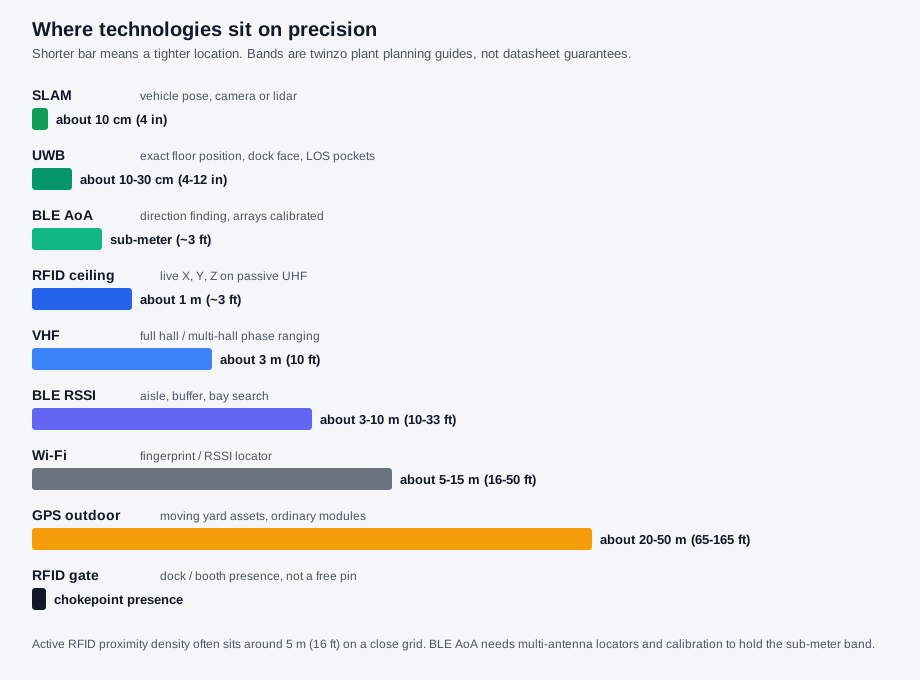
The Journey rule is different from the radio comparison. Scale is Step 03 on the path in five steps from correlation to the operational digital twin. The plant extends a working indoor spatial layer past the door. It does not open a second unrelated RTLS program with new IDs, a second map language, and no join to indoor pull history.
What the handoff must name
A durable handoff names three facts. Which outdoor identity (trailer, container, yard tractor, or ASN-linked shipment) maps to which indoor object (cage, pallet, stillage, or tagged mover). Where the coverage boundary sits: gate geofence, dock face, or apron edge. Who records the custody change when outdoor presence ends and indoor track starts. Without those three, both screens can be true while the line still cannot find the load.
That continuity keeps the spatially oriented dataset additive. Outdoor dwell and indoor dwell can share one object timeline. Later correlation and causality analytics can ask whether gate waits precede line starves on the same flow. Live internal logistics, stored history, and pattern work stay equal twin jobs across the boundary.
What a second RTLS project looks like in practice
A second project invents outdoor asset IDs that never map to indoor racks. It buys a yard dashboard the dock team uses while production keeps a separate hall twin. It treats GPS arrival at the geofence as "delivered" while the cage still sits on the trailer outside indoor coverage. It funds outdoor tags before indoor position analytics and logistics orchestration have owners. Those patterns break the compounding rule in each early layer must still earn money when the next one lands.
Same-move continuity decisions when one physical tag must stay visible through the wall are covered in indoor and outdoor on the same move. Whether scale itself is the right milestone is covered in end-to-end logistics: when the journey leaves the single hall.
Systems of record stay split. The spatial record should not
Yard management can keep owning appointments, trailer states, and door assignment. WMS and MES keep their transactions. The twin journey asks for a shared place-and-time join at the boundary so Industry 4.0 interconnection is more than two healthy apps. People should not remain the undeclared join between yard truth and hall truth, a pattern named under people still carry the join between plant systems.
Indoor pull through AOS / FGS stays a hall job. Do not rewrite yard language into aisle acceptance, or aisle acceptance into trailer scheduling. Keep scopes clear and identities continuous.
How teams decide without buying a second island
1. Start from an indoor object the shift already tracks - Extend that ID outdoor, or define an explicit map from trailer or ASN to that ID at the gate.
2. Draw one boundary and one custody owner - Gate, dock face, or apron. Name who writes the handoff event.
3. Judge success by continuity, not outdoor tag count - A successful scale step shows one history across the boundary for the scoped flow.
4. Keep hall search and pull paying - Position analytics and orchestration remain daily work while outdoor coverage grows.
Hall product paths remain internal logistics optimization and material order automation. Get in touch if you want to design the handoff rule before a second RTLS budget lands beside the first.