Zone presence vs medium-precision logistics track
Coarse zone presence answers which wing or gate. Aisle logistics needs medium precision around 1–3 m (3–10 ft), so buying one accuracy band does not deliver the other.
Two accuracy jobs that get sold as one
Zone presence answers which wing, which hall section on the order of roughly 2,000 m² (~21,500 ft²), or whether a vehicle passed a chokepoint or gate. Industry RTLS guides call the same class symbolic or choke-point locating: presence in a named area, not a continuous aisle coordinate. It is low accuracy by design. Medium-precision location answers which aisle, bay, or buffer the mover or load sits in, typically around 1–3 m (3–10 ft). That band is already precise for most plant search, utilization, flow, and many no-go zone jobs. Sub-meter (~3 ft) work is a third job for exact floor position and dock-face confirmation.
Mixing the labels is how location RFPs fail. A team funds zone presence, then expects nearest-driver assignment and missing-cage find. Or a brochure quotes 1–3 m (3–10 ft) and calls it zone-level, which confuses buyers into thinking aisle track is somehow coarse. Keep the words apart. Logistics tracking for internal moves almost always means the medium-precision band first. The radio survey that picks a modality sits elsewhere. This page stays on the place question you are funding.
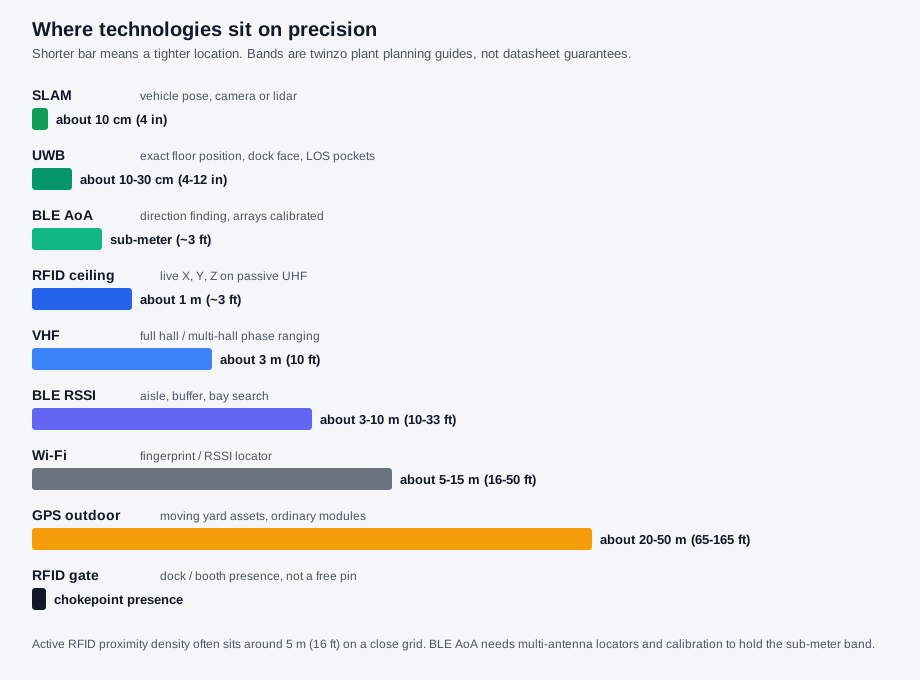
What each band can support on logistics tracking
Zone presence can prove a truck is still on site, entered a building, or crossed into a large area. It can support crude utilization per building. It cannot pick the free forklift in the right bay or show which supermarket lane holds the cage. Gate and portal reads are the same class: a crossing event, not a path down the aisle after the door.
Medium precision supports free-truck claim, aisle search, buffer dwell areas, empty-path overlays, and shared-aisle heat. That is the band most internal logistics and forklift tracking pilots should name first. An real-time location system (RTLS) or other indoor positioning build that only reports wing presence will not end buffer walks, even when the dashboard says location.
twinzo's hall jobs for logistics usually sit in the medium-precision band on a map people trust. Live positions feed internal logistics optimization and asset tracking on the shift. The same places are stored in the spatially oriented dataset under the view, so later pattern work and correlation and causality analytics can ask which aisle waits keep preceding line stops. Free-truck claim is under where the free forklift actually is. Radio comparison peers sit under compare RTLS technologies and start with the decision, not the technology.
How RFPs mix wing presence with aisle track
Many location RFPs aim to cut search and empty travel, then define success only as gate entry into a wing about 2,500 m² (~26,900 ft²). A pilot can meet that zone requirement and still leave aisle search unresolved. Wing presence on the dashboard is not bay presence. The vendor did not fail the written test. The plant never wrote the aisle question in meters (feet).
Rewrite the success test before the radio name: nearest bay within 1–3 m (3–10 ft), or wing presence only. Outdoor yard GPS versus indoor hall track is a related scope split under outdoor yard GPS vs indoor hall track. Map fidelity still matters once precision is right. A correct meter (foot) reading on a lying layout will not earn driver trust. That decision is under the map that logistics will trust.
Sub-meter is a third spend, not the logistics default
Exact floor position, often about 10–30 cm (4–12 in) where line of sight holds, matters when near the mark is not on the mark: a dock face, a tight safety cell, a confirmation that the vehicle is in the slot. That is not the default hall-wide spend for aisle search, fleet load, or industrial fleet management heat maps. Many no-go zones already run at medium precision when aisle-scale presence is enough. How to keep the tight band on the marks that need it is under exact floor position only where the mark matters.
How teams refuse the wrong accuracy buy
1. Write the shift question in one sentence before any radio name - Wing presence and aisle find are different sentences.
2. Reject zone presence as a synonym for 1–3 m (3–10 ft) - That band is medium precision. Do not accept zone-level as a label for aisle-grade track.
3. Save sub-meter (~3 ft) for exact floor position and dock-face proofs - Do not make exact floor position the default logistics track spend. Medium-precision no-go zones are a separate, valid buy.
4. Pilot coverage on the aisles you actually search - Wing-only coverage leaves bay search and dwell unresolved, and it will not fill a useful place-and-time record for continuous improvement.
Logistics location work sits under internal logistics optimization and features. Production on the same hall is under production monitoring. Pricing is under pricing.
Get in touch if you want to walk whether your location RFP asks for wing presence or for aisle-grade logistics track.