Tagging the mover vs tagging the material
Mover tags and material tags can share the same hall radio. They still answer different logistics questions and usually need separate pilot budgets.
Two objects, two logistics questions
Tagging the mover means every forklift, tugger, automated guided vehicle (AGV), or similar powered unit carries a continuous location. That is forklift tracking and broader industrial fleet management on the floor. It answers who is free, where the fleet saturates, and how much empty travel the trucks burn.
Tagging the material means cages, pallets, totes, stillages, or tools carry location. That is load-side asset tracking. It answers search and find, buffer dwell, and whether WIP is actually where inventory management claims. Both jobs use a real-time location system (RTLS) on the same hall. They are not the same purchase.
What each design can and cannot prove
Mover-only tracking proves truck paths and live fleet position. After drop, where the cage sits is invisible unless a task record and last-known drop place are good enough for your search tolerance. Industry stacks often treat vehicles and loads as separate layers for that reason: vehicle tags show route, congestion, and idle time, while carrier tags keep dwell and find after the truck leaves.
Material-only tracking proves where loads sit and how long they wait. It does not show which free truck is nearest unless drivers or vehicles are tagged too. Mixing both object classes in one thin pilot often answers neither question well. Cost math for a second object class is under tracking material is a separate purchase.
Accuracy band for either logistics job
Medium precision around 1–3 m (3–10 ft) is typically enough for aisle, bay, and buffer logistics on movers or loads. Coarse zone presence that only names a wing or gate does not stop a buffer walk or prove free capacity in the right aisle. Sub-meter (~3 ft) is a different buy for exact floor position, not the default cost of the first tag class. Many no-go zones already work at medium precision when aisle-scale presence is enough.
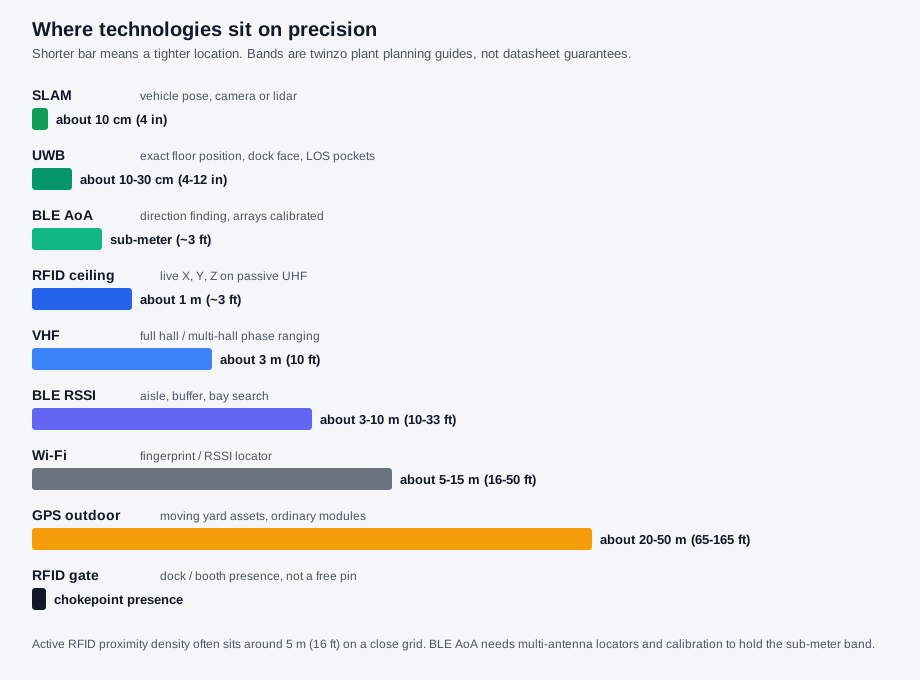
Match the radio to that decision in start with the decision, not the technology. Accuracy language for logistics track versus wing presence is under zone presence vs medium-precision logistics track.
How plants usually sequence the first tag class
Sites that already lose paid time on radio dispatch and empty loops usually fund movers first, then add tags on the cages that hide most often. Sites that already lose paid time on missing material and supermarket walks usually fund load tags first on returnable packaging, not on every one-way packaging carton. Returnable hosts amortize hardware across many trips. Expendable packs usually stay on scan events or ride a tagged pallet rather than carrying a durable tag on every carton.
Either sequence is a practical lean manufacturing move when the first class proves a measured decision before the second class expands the tag count. That is also how asset management stays scoped to the objects that cost money this quarter. Free-truck claim depth is under where the free forklift actually is. Cage find depth is under searching the hall for a missing cage. Go or no-go economics for each object are under when RTLS makes sense for forklifts and when RTLS makes sense for material.
Yard trailers are a third object
Outdoor trailers and yard slots are a different scope from hall movers or hall loads. Gate or yard presence answers dock and parking questions. It does not replace indoor logistics tracking for forklifts or cages. Keep yard and hall object classes on separate success tests. That handoff is under outdoor yard GPS vs indoor hall track.
One map, three equal uses of the record
twinzo can show movers and loads on one map people already trust. Live search, fleet load, and material find feed shift internal logistics work. The same places and times land in the spatially oriented dataset under that view. Continuous improvement and later correlation and causality analytics read that shared record to test which loads keep preceding which empty loops, and which idle clusters keep preceding the same shortage. Live operations, the stored place-and-time record, and pattern analytics are equal uses of the same twin.
Ordering on tracked movers is under material order automation. Production waits on the same hall are under production monitoring. Capability depth is on the features overview.
How to choose without tagging the whole plant
1. Rank last month's pain: empty loops and radio, or missing material walks - First tag follows the larger paid-time loss.
2. Count how long loads sit after the truck leaves - Long sits push you toward material tags sooner.
3. Prefer returnable packaging when you fund load tags - Skip expensive continuous tags on high-volume one-way packs unless a miss cost proves otherwise.
4. Keep yard trailers and hall objects on different scopes - Gate presence is not hall logistics tracking.
5. Pilot one object class on one loop before expanding - Prove the decision, then add the second class.
Pricing for a phased rollout is under pricing. Get in touch if you want to walk which object your first logistics tracking pilot should carry.