Small fleet in a large hall
A large hall with only a handful of forklifts should not buy a roof grid priced for dozens of vehicles. Put location on the truck so the six-month return test still has a chance.
What this combination is
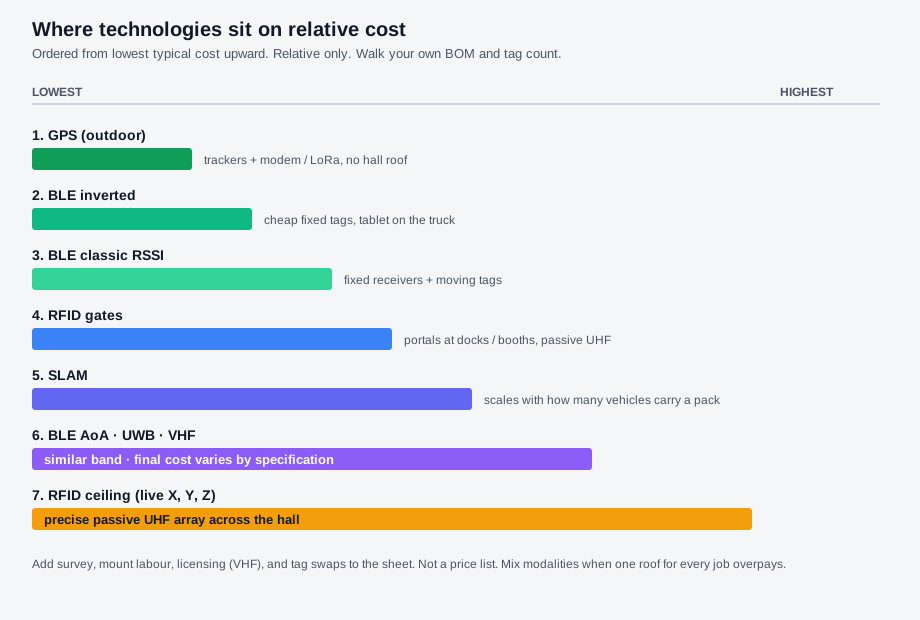
The decision is the mismatch of area and fleet count. A roof on the order of 100,000 m² (about 1.08 million ft²) with only a handful of trucks is not the same purchase as that roof with dozens of trucks, and it is not the same purchase as a compact hall with the same handful. Fixed RTLS locators, classic BLE receivers, angle-of-arrival arrays, and UWB anchors grow with covered floor. Tags on the trucks are the smaller line. Industry cost guides treat that infrastructure as euros (dollars) per square metre (per square foot), so empty bays still cost money even when few vehicles ever enter them.
The combination that fits this mismatch puts the sensor pack on each truck. SLAM and similar vehicle-mounted builds scale with how many movers you instrument. They still need a map of the hall and a backhaul path, but they do not require a locator in every bay before the first continuous path exists. How that family reports a location is described in SLAM for RTLS. The opposite arithmetic, one large roof shared by a large fleet, is described in one large building and a large fleet.
Why a roof-first quote fails the six-month test
ROI for forklift tracking and broader industrial fleet management usually comes from cutting empty travel, releasing leased trucks, or balancing load across the few drivers you already have. A site-wide grid only pays when enough trucks share the same anchors. With a short fleet, the avoided lease of one truck cannot repay a locator layout priced for the whole floorplate inside six months. Indicative industry ranges put medium-precision BLE-class infrastructure in the low euros per square metre (per square foot) and dense UWB several times higher, before tags, software, and integration. On a 100,000 m² (about 1.08 million ft²) roof those area lines dominate the quote long before a handful of trucks can share them.
Sparse fixed beacons can still mark which bay a truck entered when a continuous path is not required. They remain a supplement. They are not a reason to carpet the roof for a handful of trucks. The compact-hall alternative that keeps inverted BLE on a small footprint is described in small fleet in a small hall. How hall size and fleet size pick the stack is described in the six-month return depends on the combination.
What the truck pack still does not buy
A pack on the truck shows empty loops and dwell on the hall map. It does not by itself replace a shouted job. If operators still phone drivers between those loops, add AOS (commonly known as a forklift guidance system) so the next need is a claimable work order. That software line is independent of roof area. Call-first sites that are not ready for any location hardware are described in calls and micro-stops before a location grid.
Most corridor and buffer decisions need only medium-precision location, about 1–3 m (3–10 ft). Exact floor position on a mark is a smaller, local purchase, not a hall-wide upgrade. Keep that tighter band off this quote unless one dock face or safety cell truly needs it, as described in exact floor position only where the mark matters.
What the paths still store
Live search and empty-travel cuts are only one use of the locations. Paths from the packs still belong in the spatially oriented dataset, the place-and-time record under the live view. Correlation and causality analytics can ask which long empty runs keep preceding a starve or overtime on this floor. A small fleet produces a thinner record than a hundred trucks. It is still a hall record that continuous improvement and later models can read, not only a logistics desk tool. twinzo treats that join as part of internal logistics optimization and production monitoring.
When the pack arithmetic flips
Each extra forklift needs its own pack, map update time, and mount work. A fleet that grows into the dozens changes the cost curve, and a shared indoor grid can become the cheaper template for the same roof. Until that growth is real and booked, buying the large-fleet layout early spends money on hardware the shift does not use, so a six-month return is unlikely. Hidden install and survey lines that still appear on either path are listed in what to include when calculating RTLS ROI.
How teams choose the pack instead of the roof
1. Divide the locator quote by the trucks that will actually carry work - If one avoided lease cannot repay the area line within six months, the roof grid is premature.
2. Price a pack per current truck, plus AOS if calls are still the dispatch method - Location and claimable jobs belong in internal logistics and material order automation as separate lines, not one blended cell.
3. Re-price a shared grid only after the fleet count justifies the area - Do not pre-buy the 100,000 m² (about 1.08 million ft²) template for today's short fleet.
4. Keep exact floor position off this purchase unless one mark requires it - Medium precision is enough for corridor waste and most no-go zone presence.
What the product can do is on the features overview. How a rollout is priced is on pricing.
Get in touch if a large hall and a short fleet are being quoted as if they were the same project as a dense shared grid.