Search and find with RTLS
When the booked bin is wrong, the plant still has to find the tagged cage or pallet before the line waits. Search and find with a real-time location system (RTLS) ends that hunt on a live hall location.
What search and find means on the floor
Search and find is the job of locating a tagged pallet, cage, tool, or semi-finished lot when the system location is wrong or stale. Warehouses lose pallets after an informal put-aside. Plants lose WIP cages that left the designed buffer for a quality hold, space clearing, or a temporary park that became permanent. The question is not only where the lot sits. It is how often the hunt happens, which paths the material actually took, and how much cash sits in those forgotten piles.
Last-scan records fail this job. A barcode at putaway was true at the scan. A WMS bin or an ERP transfer was true when someone confirmed. Neither moves when a forklift drops the load one aisle over because the assigned face was blocked. Industry warehouse and manufacturing practice treats that gap as unpaid motion and waiting: people walk, lines wait, and the ledger still looks tidy. Live location closes the gap so a supervisor types an ID and sees the hall before anyone starts walking.
Why put-aside WIP becomes invisible capital
Semi-finished batches get parked for real reasons: a quality check, a missing component, a line change, a blocked face. Without a live location, those parks leave no durable map. The cage leaves the standard route. The MES may still show the order in process. Finance still values the WIP on the books. Operations cannot see which north buffer holds the expensive lot versus empty stillages.
That is how money sits on the floor without a clear owner. Plants that carry heavy semi-finished buffers often release more WIP onto the floor when nobody trusts where the last batch is. Lean manufacturing already names excess inventory, motion spent hunting parts, and waiting for missing material as waste. A clipboard count on Tuesday still misses the night put-asides. Search time is the visible pain. Tied-up capital in the wrong place is the quieter one. That WIP trust problem deepens under when RTLS makes sense for material.
What RTLS shows that WMS bins do not
RTLS keeps a continuous location on tagged pallets, cages, or totes. twinzo search turns an ID into a place on the live map: which facility zone, which aisle, which buffer. Asset tracking here is not a monthly inventory project. It is the same stream used during the shift when a station is waiting on a lot the books still place in the designed bay.
Over days, the same locations rebuild true material flow. Spaghetti diagram paths show where lots actually traveled versus the process map. Dwell and a heat map show which side buffers collect put-aside WIP. Pair location with batch or SKU value from ERP and the plant can say not only where the lot sits, but roughly how much money sits in that forgotten bay. That is the bridge from search to inventory management and buffer management on the same twin used for internal logistics optimization.
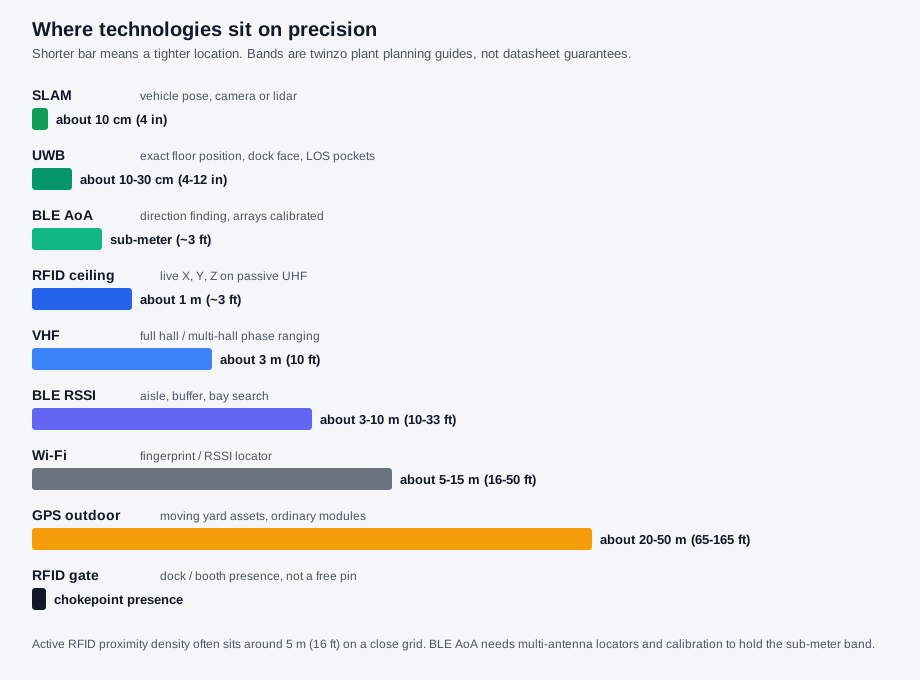
Medium-precision location (about 1–3 m / 3–10 ft) is usually enough to end a hunt. You need the right aisle or buffer, not exact floor position on a mark. Coarse zone presence only answers which wing or chokepoint and does not stop a buffer walk. Static bin stock that never moves can stay on ERP coordinates without radio tags, as in live 3D stock from ERP without RTLS. Moving WIP and frequently misplaced materials are the RTLS search case. For how RTLS works on the floor, see what RTLS is. For the logistics-tracking precision split on a missing cage, see searching the hall for a missing cage.
When tagging is worth it: value, volume, and packaging
The key metric is not whether the plant can track everything. It is whether the cost of a miss beats the cost of the tag and the system behind it. Start with the value of the searched item and the value of non-delivery. A low-cost consumable that is easy to reorder rarely pays for continuous location. A high-value semi-finished lot that parks wrong for three days ties up real cash and still may not justify radio if the hunt is rare.
Non-delivery changes the math fast on just-in-time (JIT) feeds. If a missing stillage stops a sequenced customer line, line-down cost and lost hours alone can pay for the search stack before anyone finishes counting walk time. Sheer volume matters the same way: hundreds of drifting cages per week create a standing search cost that a handful of high-value tools do not. Rank candidates by miss cost times frequency, not by how neat the map would look.
Returnable packaging decides what you can spend per tag. A reusable stillage, pallet, or tote that cycles for years can carry a durable tag and still win on total cost of ownership. One-way packaging that leaves with the customer cannot. That split also sets update needs. Returnables on a busy JIT loop often need live location while the load is in the hall. Lower-risk stock may only need last known position after the last gate or putaway event, cheaper hardware, and less battery load. Match tag cost and refresh rate to packaging life and miss cost, then tag only that slice. Whether the first tag class should be the mover or the load sits under tagging the mover vs tagging the material. For the accuracy trade-off that comes next, see start with the decision, not the technology.
How teams run search and then read the money
1. Tag what the miss cost justifies - Semi-finished cages, returnable stillages, high-value components, and any lot whose hunt or line-down cost beats the tag. Skip static racking and one-way packs that leave the site.
2. Make search a typed ID, not a radio chain - Operator or planner enters the batch or pallet ID, sees the live location, and sends the nearest mover. Measure hunt minutes before and after.
3. Review dwell outside standard buffers - Weekly, list lots that sat in unexpected zones beyond a threshold. Those are put-asides that never returned to the flow.
4. Value the parked WIP - Join location and dwell with unit cost or order value from ERP. Rank forgotten capital by value sitting idle, not only by count of cages. Decide which piles to clear, which buffers to redesign, and which put-aside rules need an owner.
Find the lot, then keep the place-and-time record
Stopping the daily hunt is only one reader of the same location layer. Live search feeds shift ops and asset management on returnables that keep leaving designed buffers. The stored places land in the spatially oriented dataset under the live view, so planners can later ask which corners keep collecting put-aside WIP. Correlation and causality analytics need those repeated places and times, not only the one successful find. Live logistics, the place-and-time record, and that pattern work sit as equal uses of the same digital twin. That is also how a practical smart manufacturing program turns search waste into evidence instead of another disconnected dashboard.
Side jobs that never made the process map are covered in unknown processes on the live floor. Call-offs that depend on knowing material is really there connect to material order automation. Production waits on the same hall sit under production monitoring. Capability depth is on the features overview. If people still walk for batches the system says are in a bin, put location on the loads that drift and read both search time and WIP value by zone. The twin only pays when someone clears the put-aside or redesigns the buffer. Get in touch if you want to walk the same search-and-WIP picture on your own facility model.