Tracking material is a separate purchase
A paid forklift tracking stack does not fund a tag on every cage. Material location is a second purchase, and it needs its own payback test.
Why fleet location and material location do not share one price
A forklift fleet is tens of tracked units. Those trucks already burn fuel, leases, and empty loops, so a modest set of vehicle tags and tablets can pay back within six months when the combination fits the hall. Cages, stillages, and other returnable packaging multiply hardware, batteries, spares, and replacements by how many items you tag. That multiplier is asset tracking cost on the load side, not a free add-on to industrial fleet management.
A 100,000 m² (about 1.08 million ft²) roof does not by itself justify a battery tag on every cage. Hall area is the wrong count. The time people spend hunting, and the WIP that goes missing against inventory management truth, have to pay that extra purchase back within six months. Which object to tag first is settled in tagging the mover vs tagging the material. This page is about what the material class costs after the fleet class is already on the map.
Match the material layer to how the item moves
Keep the fleet real-time location system (RTLS) combination that already fits the building: inverted BLE in a small hall, a pack on the truck when the hall is large and the fleet is small, a shared grid when both are large. That combination is judged in the six-month return depends on the combination. For material, pick a separate layer that matches the path the item actually takes.
Dock or aisle gates answer whether a tagged load passed a chokepoint. Bay exciters or proximity readers answer which bay heard the item. Ceiling RFID can report live position for many passive items when a battery on each one will not pay. VHF fits when many items must stay visible across halls and yards on sparse gateways. That indoor and outdoor case is described in indoor and outdoor on the same move.
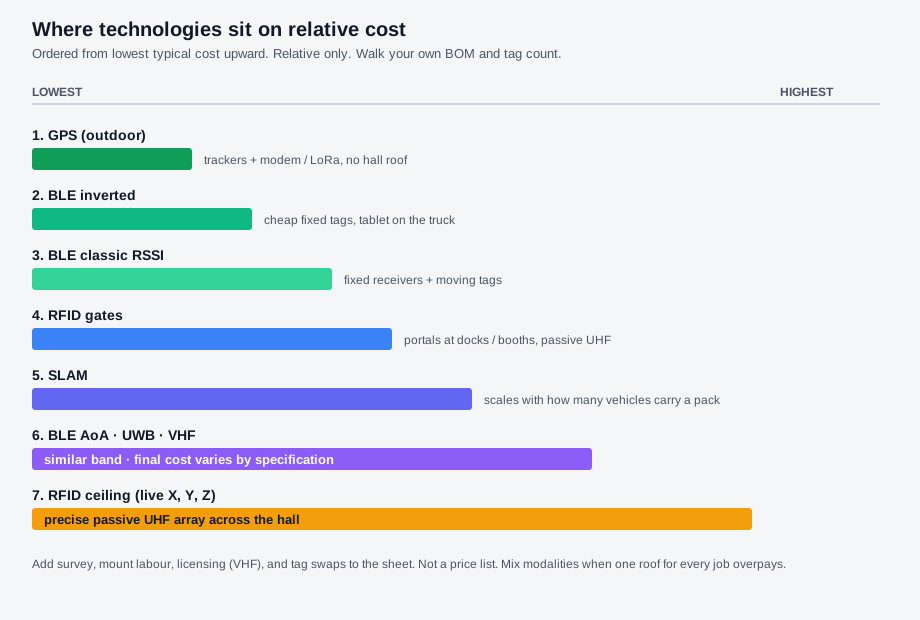
Industry practice treats a portal or gate read as the cheap identity check and continuous location as the expensive one. Most warehouse questions about a pallet are answered at a gate, a bay, or a handheld exception walk. Paying for a continuous trail on every cage is a separate decision from proving a truck crossed the same dock. Passive tags keep unit cost low when presence at a read point is enough. Active tags and dense locators belong only where hunt minutes or line stops need location between those points.
When material tracking earns the cost back
Fund material tracking only where people already lose paid time hunting, where a missing load stops a line, or where lost returnables themselves burn replacement spend. Medium precision around 1–3 m (3–10 ft) is usually enough for bay and buffer find. Coarse zone presence that only names a wing rarely stops a buffer walk. Sub-meter (~3 ft) is a different buy for exact floor position, not the default cost on every cage family.
A documented white-goods hall recovered about 20 minutes of production a day and removed micro-stops with pull dispatch. That came from coordination, not from a tag on every cage. The production result is described in twenty minutes of production back every day. It does not justify tagging every cage if nobody measured the hunt. One-way packaging cartons are a poor host for durable hardware. Returnable hosts amortize a tag across many trips. The go or no-go mix of WIP capital, delay, volume, and packaging sits under when RTLS makes sense for material.
What funded locations still buy equally
Locations you do fund for movers, and for materials that passed the hunt test, still share one hall record. Live search and fleet load feed internal logistics work the dock already owns. The same places and times land in the spatially oriented dataset under that view. Continuous improvement and later correlation and causality analytics read that shared record to test which missing cage families keep preceding a starve, and which idle buffers keep preceding the same shortage.
Live operations, the stored place-and-time record, and pattern analytics are equal uses of the same twin. Expanding the material tag count just to fill a nicer map fails the six-month test. Expanding it where measured hunt minutes and lost WIP pay for the hardware is how asset management and lean manufacturing stay scoped to the objects that change money this quarter.
How teams keep the two purchases apart
1. Finish the forklift purchase first, and check that it pays back within six months on that building - How that test works is described in the six-month return depends on the combination.
2. Count hunt minutes and lost WIP on one cage family before any material tag order - Building size is not the count. Scope total cost of ownership to that family only.
3. Match the material technology to the path - Gate presence, bay presence, passive ceiling location, or VHF when the item crosses buildings. Do not reuse the fleet radio choice as the default material stack.
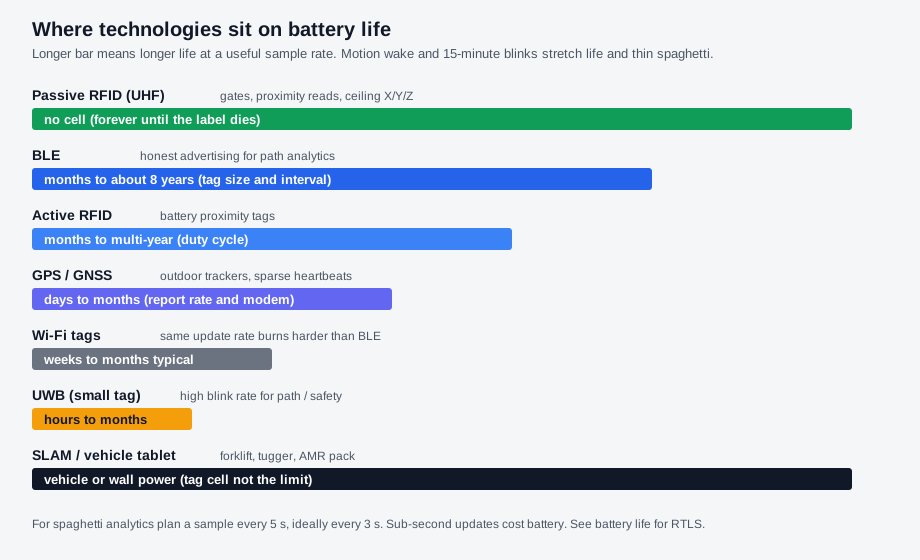
4. Include battery replacements and remount labour in the cost that must pay back within six months - A cheap tag that dies in year two is still part of this purchase. What to include is listed in what to include when calculating RTLS ROI.
What the product can do is on the features overview. How a rollout is priced is on pricing. Production waits that sit on the same hall are under production monitoring.
Get in touch if a cage-tag line is being added because the building is large, not because anyone measured the hunt.