Maintenance optimization with RTLS
Maintenance response often loses minutes to crew and spare travel that a CMMS never proves. Maintenance optimization with location shortens that clock without buying another vibration model.
What this use case is
Here the job is response geography. A CMMS still owns the work order. Location answers how much of mean time to repair (MTTR) was wrench time on station versus travel to the asset, the parts cage, and back. Plants that already run TPM can still hide that travel when the highest-failure press sits furthest from primary spares and crews treat the long walk as normal. OEE then drops on availability while the dashboard still looks like a skill or parts-quality problem.
Maintenance craft studies commonly treat wrench time as a minority of the shift when the shop still fights reactive work. Travel, parts search, waiting, and paperwork fill the rest. Storeroom and maintenance layout practice has long placed stores near the work that fails most, or staged satellite cabinets when the hall is long, because round-trip distance is paid downtime. Continuous location makes that distance a measured pattern instead of a habit.
Why work orders understate response time
A ticket says 'arrived' when someone taps a status, not when they reach the cell. It says 'parts drawn' when the store issues a line, not how far the tech already walked empty-handed. Radio dispatch often sends the nearest voice, not the nearest qualified person who already carries the right spare cart. Night shifts repeat the same long trek when nobody compared a failure heat map to parts storage on the floor plan.
Predictive maintenance can warn that a bearing will fail. It does not move the spare closer to the machine that fails most. Without crew and cart asset tracking, engineering optimizes diagnosis while the floor still pays for walking. That gap is the same class of hidden movement covered under unknown processes on the live floor, aimed at maintenance response instead of logistics side jobs. Sending the wrong trade on the first roll is a sibling cost under what it costs when the wrong crew rolls first.
What RTLS shows on a breakdown
A real-time location system (RTLS) reports where tagged technicians, tool carts, and critical spare cages sit during the shift. The location stream rebuilds the path from workshop to failed asset, optional detours to the parts store, and time on station. Dwell at the machine versus dwell at the cage splits wrench time from hunt time. A heat map of crew travel over weeks shows which cells pull the most response walks. Spaghetti paths show the repeated out-and-back to a remote warehouse. That empty motion is non-value-added work on the maintenance clock, the same waste class lean manufacturing already hunts on empty logistics moves.
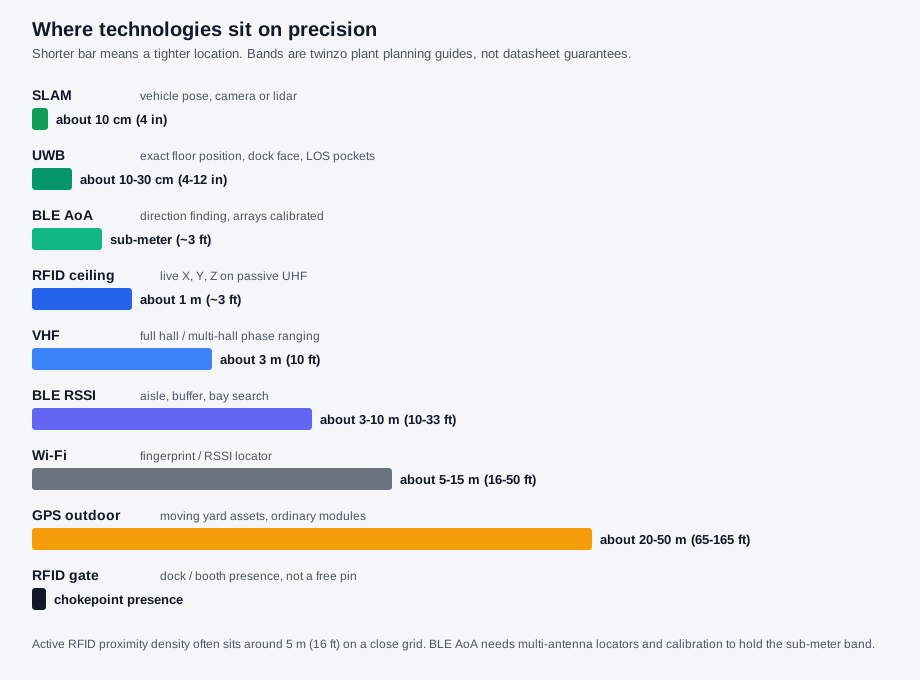
Medium-precision location around 1–3 m (3–10 ft) is enough for this job. Knowing the tech is in the north press bay versus the central parts cage matters more than exact floor position on the footpath. Sub-meter (~3 ft) exact floor position is not required to measure and price a long walk. The same live hall view used for production monitoring can sit beside maintenance response so supervisors see both the stopped line and who is already moving toward it. For how RTLS works on the floor, see what RTLS is. Benefit framing across fleet, WIP, and maintenance sits under where RTLS benefits show up.
Equal jobs for the operational twin
An operational digital twin does three equal jobs for this use case. Live shift operations show the stopped cell and the moving crew so dispatch is not a radio guess. The same stream fills a spatially oriented dataset: the spatiotemporal record of response paths by place and time under the live view. Correlation and causality analytics then ask which cells keep pairing high failure counts with long parts distance, and which staging changes actually shortened travel share afterward. Continuous improvement and asset management read that record as much as the supervisor reads the live map. A smart manufacturing program that only watches the next ticket still misses the pattern that keeps repeating across weeks.
CMMS remains the planner and the system of record. Preventive schedule truth on the same hall is a sibling join under preventive maintenance only works when CMMS meets the hall. This page stays on travel versus wrench during breakdown response.
How teams cut time to solve
1. Baseline a set of real breakdowns - Capture signal time, first arrival at the asset, parts-cage visits, and restore time for two to four weeks. Separate travel minutes from wrench minutes on the location stream, not only on status taps.
2. Overlay failure frequency with parts distance - Rank assets by breakdown count. Measure walking distance from each to the primary spare-parts warehouse, and report it in both meters and feet. The machine that fails most and sits furthest is the first layout or staging candidate.
3. Fix the pattern, not only the ticket - Stage high-runner spares nearer the hot cells. Pre-stage parts carts for the top failure modes. Park a satellite cage on the far wing. Change dispatch so the nearest qualified tech with the right spare cart moves first.
4. Re-measure travel share of MTTR - After the change, the same location stream should show shorter paths and less cage dwell. If wrench time stayed flat while travel dropped, you optimized response geography, which is the goal of this use case.
What to watch after the redesign
KPIs that keep the redesign honest are travel share of MTTR, walking distance from top failure cells to primary spares, and time from andon to first on-station presence. Prove the change on your own hall. Do not borrow a vendor percentage. A related walked-cost story sits in walking still costs more than most dashboards admit. For when continuous location helps versus when a clipboard is enough, see when RTLS makes sense for people. How a floor request becomes tracked work is under how a floor request becomes a work order.
twinzo can place crew and spare location on the same operational hall as line state so production monitoring and maintenance response share one picture. Capability depth sits on the features overview.
Put the spares where the failures walk
If downtime still includes long empty walks to a remote parts warehouse, instrument the crew and read the paths before you add headcount. Shorten the geography of response, store the place-and-time record, and re-check travel share on the same digital twin. Get in touch if you want to walk the same maintenance-response picture on your own facility model.