Calls and micro-stops before a location grid
When calls, patrol walks, and line micro-stops dominate the waste, fund claimable material orders first. Add a location grid only after residual empty travel is what remains.
What this spend decision separates
Two different wastes often share one purchase request. Coordination waste is the operator-to-driver phone or radio call for routine supply, the purposeless patrol between verbal jobs, and the short line waits that never earn a downtime code. Path waste is the empty travel distance a truck still drives after a job is already claimed. Industry lean practice already treats radio-on-call material moves and empty repositioning as common internal logistics drains. Classic forklift-guidance stacks and tracking stacks also split the jobs: a forklift guidance system owns demand and assignment, while a logistics real-time location system (RTLS) owns measured paths, dwell, and fleet load.
Mixing the two into one roof-wide quote hides which module can pay back first. A plant can cut most voice traffic and many material waits without a locator in every bay. A plant can also still need location after pull is honest, because claimable jobs do not draw the empty return path. This page settles the sequence: which measured waste points to which combination, and which documented euros belong on which bill.
When pull is the combination that fits
If the counted waste is operator-to-driver calls, purposeless patrol, and minutes the line waits for material, fund twinzo's AOS (commonly known as FGS) first. A button, scan, e-Kanban flip, or MES link becomes a claimable work order under a material call-off. Eligible drivers see origin, destination, and priority. One driver accepts. The order leaves the open pool. The fleet does not have to be large, and the hall does not need a locator in every bay, for that change to pay. That is the core of material order automation.
A documented 55,000 m² (about 592,000 ft²) white-goods plant invested €100,000 (about $110,000) in that pull class. Unnecessary patrol fell by about 95%. The plant recovered about 20 minutes of production every day. Line micro-stops tied to late material were removed. First-year increased production value was €5,080,000 (about $5,588,000). A documented 30,000 m² (about 323,000 ft²) automotive Tier-2 hall cut operator-to-driver calls by about 90% and forklift patrolling by more than 95% on the same class of pull, with no euro figure published for that change. Both are coordination results. Depth on the production minutes sits under twenty minutes of production back every day. Depth on the call cut sits under phone calls still coordinate most internal moves.
When a location grid is the next purchase
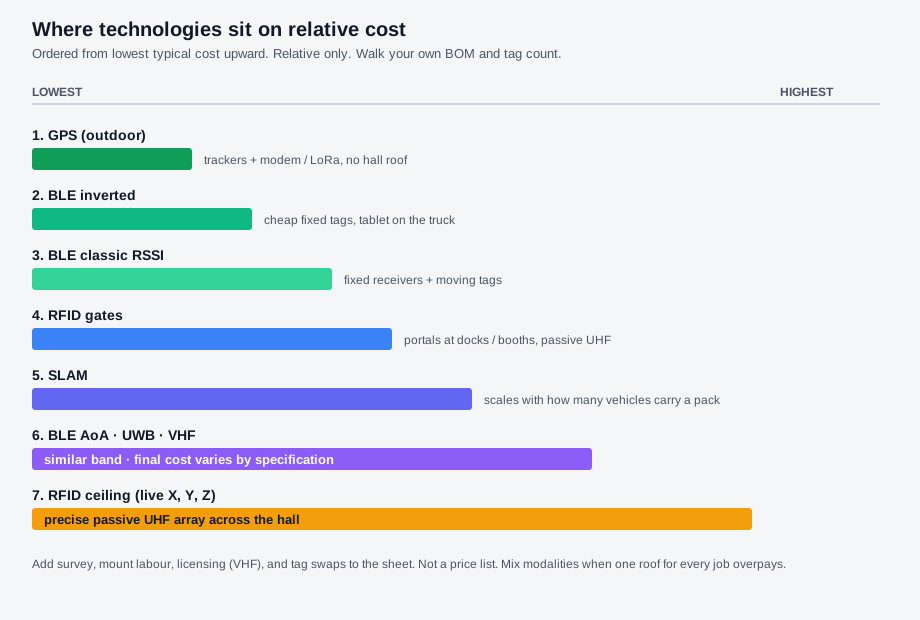
Pull removes the search between verbal jobs. It does not measure the path the truck still drives empty after the job is claimed. When that residual empty travel is large enough to release trucks or protect the recovered line minutes, add the location combination that matches the building. Inverted BLE fits a small hall. A pack on each truck fits a small fleet in a large hall. A shared roof grid fits one large roof and a large fleet. Those choices are the RTLS combinations in the six-month return depends on the combination. Medium-precision location around 1–3 m (3–10 ft) is enough for most aisle, buffer, and bay forklift tracking reviews under internal logistics optimization.
Do not use the €5,080,000 (about $5,588,000) white-goods production figure to justify a 100,000 m² (about 1.08 million ft²) location grid. That figure belongs to the pull case. A combined customer often runs both layers. A single ROI cell still has to keep them apart. How the two share one hall is described in when pull and path share one hall.
What the claim log is worth before locations arrive
Closed work orders are already a record of who needed material, who accepted, and how long the move took. That trail is enough to judge the pull investment on call volume, patrol share, and recovered line minutes. Lean manufacturing can already treat those closed events as proof that waiting and unnecessary motion fell, without waiting for a full coverage map.
When positions arrive later, they join the spatially oriented dataset on the same hall. Live logistics then reads free capacity and residual empty corridors. Continuous improvement reads the same place-and-time history after the project sponsor leaves. Correlation and causality analytics can ask which request gaps keep preceding a micro-stop. Those three uses stay equal. A stack that only counts fewer phone calls still leaves the stored record and the root-cause work unfinished. Until locations exist, do not pretend the claim log is a path map. After locations exist, do not treat the dataset and the analytics as optional add-ons to industrial fleet management.
How teams sequence the spend
1. Count calls, patrol share, and line-wait minutes on one peak week - If those dominate, fund AOS under material order automation before any roof-wide location quote.
2. Hold the location quote until empty travel is what remains to cut - Match hall size and fleet size to the location combination, not to the size of the pull investment. That sequencing is a practical smart manufacturing move when demand and place stop living in separate budgets.
3. Judge ROI within six months on the module you installed - The €100,000 (about $110,000) white-goods case is a pull reference. It is not a roof-grid reference. Each later layer keeps its own six-month test, as in each combination keeps its own six-month test.
4. Add locations as their own test when the fleet cut or protected minutes are the remaining benefit - Keep recovered production under production monitoring next to path analytics, not in one blended cell. What the product can do is on the features overview. How a rollout is priced is on pricing.
Get in touch if a roof-wide location quote is attached to a problem your calls and micro-stops already explain.