Where the free forklift actually is
Free forklift capacity is a place-and-time fact on the hall map. A voice claim on the radio is not the same thing.
What "free" means without a location
On most floors free still means someone answered the channel. A dispatcher or line lead asks who can take the move. Drivers reply from memory of where they think they are, or from the last place they remember parking. A WMS screen may show open warehouse tasks. It does not show which truck sits in which aisle right now. Industry forklift guidance and fleet tools count that gap as search time, idle time, and empty travel between jobs, the same cost plants already pay when coordination stays on the radio.
That is why forklift tracking and broader asset tracking for industrial fleet management start with continuous location on the mover. Move counts prove a drop happened. They do not prove which tagged forklift is idle beside the wait, already loaded, or still crossing a shared aisle far from demand. Without that place fact, the fleet can look large enough on paper while waits still feel random.
Accuracy that answers who is free
Logistics tracking answers the free-truck question when every mover carries a continuous location on a hall people recognize. Medium-precision real-time location system (RTLS) around 1–3 m (3–10 ft) is already enough to separate idle from loaded trucks in the right aisle or buffer. Coarse zone presence that only says the truck is in the north wing cannot show the right bay. Sub-meter (~3 ft) readings matter later for exact floor position, not for answering who is free this minute.
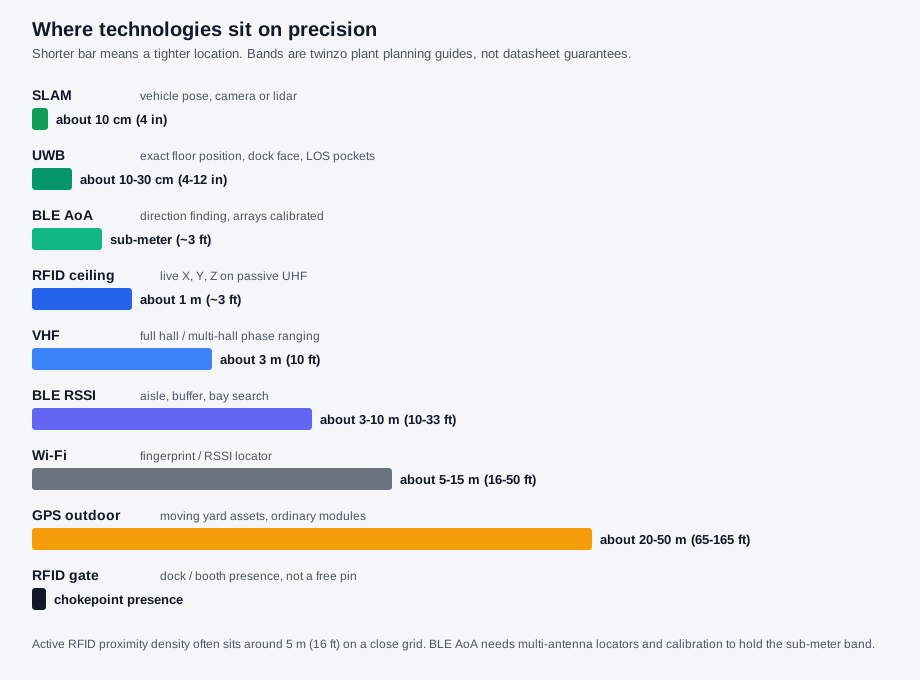
Many plants fund that medium band first because aisle-scale free capacity and most no-go zones already work there. How those bands differ from wing-only presence is under zone presence vs medium-precision logistics track. When empty travel and uneven load are the money leak, the forklift filter for RTLS is under when RTLS makes sense for forklifts.
Live location beside AOS group offers
twinzo AOS (commonly known as a forklift guidance system (FGS)) offers open jobs to a configured driver group. Every eligible driver in that group sees the work order. The first to accept owns it. Live location does not currently shrink the offer to the single nearest truck. What location does is make free capacity honest on the map beside those open jobs.
Ops can see which tagged forklifts in the group are idle near the wait, which are already committed, and which still sit far from demand. A truck that sounds free on the channel but sits 400 m (about 1,300 ft) away is no longer a mystery. Drivers can choose whether to accept. Supervisors can coach the group when idle trucks keep sitting away from open work. That is fleet management tied to place, not only to hour meters. How group broadcast differs from nearest-truck myths is under group broadcast vs nearest-truck myths. How to size those pools is under how to size and split driver groups.
What free-truck location is not
Fleet location is not a second command center full of cameras. It is not yard gate presence for trailers. It does not invent free capacity when every truck is already loaded. If every truck is busy, the map proves fleet saturation. If one truck is idle beside the buffer while the group still hunts by radio, the map replaces the guess. Nearest-truck auto-assignment is a different product class some fleet tools sell. Do not treat twinzo AOS group broadcast as that promise. Voice-first coordination costs and claimable work orders are the sibling decision under phone calls still coordinate most internal moves.
Three equal jobs on the same stream
The same location feed that shows who is free also fills three jobs plants usually fund for different desks. Live logistics uses it for search, utilization, and acceptance coaching on a hall people trust. That stream lands in the spatially oriented dataset under the live view, so idle clusters, acceptance places, and empty travel remain searchable after the shift. Correlation and causality analytics then test whether those idle clusters keep preceding the same material shortage. Funding only the live free-truck glance, without the stored place-and-time record and the pattern work, leaves continuous improvement guessing from radio stories instead of measurable place-and-time evidence.
Those three jobs matter equally for a practical smart manufacturing join between the logistics desk, the improvement team, and later models that need honest history. What a closed shift leaves in that record is under what a closed shift leaves in the spatial record. Sibling path proof is under real travel paths on the floor.
How teams decide the free-truck question is worth funding
1. Count last week's waits that started with who is free on the radio - If that phrase keeps appearing, location is the missing fact.
2. Keep AOS offer scope on driver groups, not on a nearest-truck promise - Write location success as idle visibility, acceptance place, and path proof. Separate that from who may see the job.
3. Put open jobs and mover locations on the same hall - Separate screens recreate the radio gap.
4. Review idle clusters after two weeks - If free trucks in the group still sit far from demand, membership or coaching still needs work. Rank the fleet with the same evidence under balancing forklift fleet saturation.
Live fleet search and utilization sit under internal logistics optimization, with capability depth on the features overview and claimable pull under material order automation. Production waits on the same map are under production monitoring. How a rollout is priced is on pricing.
Get in touch if you want to walk through whether your free trucks are locations on a map, or still voices on a channel.