Start with the decision, not the technology
A real-time location system (RTLS) purchase does not start with a radio family name. Name one floor question and the accuracy that question needs, then pick the technology.
What the decision is
Industrial location selection is application-driven. Warehouse and factory location work starts from the use case: how accurate the answer must be, how often it updates, how fast it must arrive, how much of the hall it covers, how well it survives metal and traffic, and how many tags you will run. Only then do you shortlist technologies that can meet those needs on the real floor. Total cost of ownership work follows the same order: score capability against the use case first, then compare cost among systems that already clear that bar. Starting from a brochure accuracy number reverses that sequence and builds the project around the demo instead of the floor job.
The decision this page owns is that sequence. Sibling pages already cover whether material, people, or forklifts are worth tagging at all under when RTLS makes sense for material, when RTLS makes sense for people, and when RTLS makes sense for forklifts. The technology survey and side-by-side charts sit under RTLS technologies out there and compare RTLS technologies. Read those after the question and the loss are written down.
Name one floor question
Write the question in language a supervisor would use on the shift: who is stuck, where, and what fails when they are stuck. 'We need visibility' is not a question. 'Drivers cannot find the last cage of that SKU while the line waits' is. The same hall often holds several losses at once. Extra trucks from empty travel, late material against takt, long search-and-find walks, uneven walking load, and repeated near misses at a shared crossing are different projects. They do not share one fix or one price. Pick the one the plant will enforce this quarter.
Use these checks in the meeting. Each one needs a place on site and a person who feels it. If nobody can point at the dock, the aisle, or the station, the question is not ready to buy against.
1. What fails this week? - One sentence, one place, one role. Name the stuck person or crew and the object that cannot be found, delivered, or kept out of a marked area.
2. Is the fleet padded by hunting? - Count trucks against moves that truly need a truck. Empty returns, two drivers sent to the same cage, and a fleet that grew because search ate the shift are a fleet management problem. A spaghetti diagram of one real shift usually shows those loops before any system diagram does. The same drain sits under the empty-round problem that still sits in most plants.
3. Which deadline slips, and how often? - Internal windows usually slip before customer windows do. Ask which station, which clock, and how often in a normal week. A complaint without a clock is not yet a project.
4. Is search time separate from line idle? - Search is the walker or driver who cannot find the cage. Idle time is the crew at the station who cannot start. A late material call-off that leaves WIP in the wrong buffer creates both. Dwell in the wrong place is often why the search starts. Do not fold the two clocks into one blob.
5. Is the walking load unfair? - Who walks the long aisle, who lifts, and who carries the heavy route while another team stays at the dock. Overall labor effectiveness is one way plants already talk about that uneven load. Count hours on the hard route before you talk about a map.
6. Is safety the event you keep explaining after the fact? - Near misses at a shared crossing, a person in a truck path, a stop inside a marked area. Ask how often it happens and who finds out too late. A no-go zone or a geofence is only a rule once the plant can say which corner and how many times a week.
Match accuracy to the next action
Accuracy is how wrong the location can be before the next action fails. It is not a brochure number to maximize. Application-driven warehouse tests already show the same split: aisle-scale goods tracking can accept about 1 m (3 ft) error for shelf-aisle assignment, while dock booking, tight safety cells, and exact floor position on a mark need a tighter floor. Plants that mix presence in most areas with tighter location only in critical interaction zones avoid over-instrumenting the whole roof.
Coarse zone presence answers which wing of the building or which chokepoint, often on the order of about 2,000 m² (about 21,500 ft²) or a gate read. Medium-precision location is about 1–3 m (3–10 ft) and is enough for most aisle, buffer, and bay logistics jobs, including many no-go zones. Exact floor position at sub-meter (~3 ft) matters when 'near the mark' is not the same as 'on the mark.' Forklift tracking and material asset tracking usually need the medium band for aisle and bay work. Safety lockouts and dock-face confirmation may need exact floor position. Write that accuracy floor next to the floor question before anyone opens a radio datasheet.
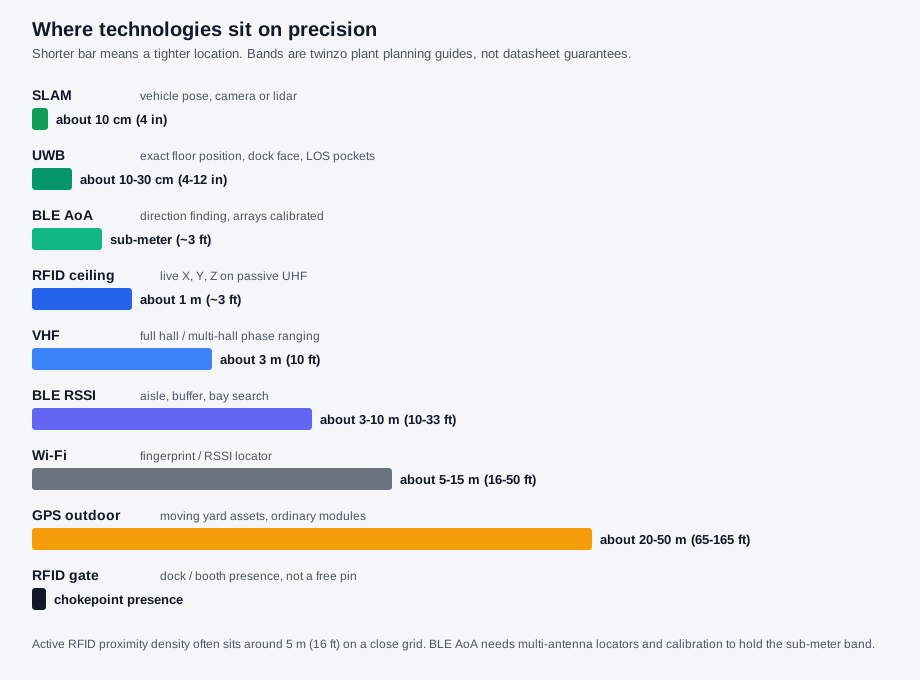
Peer radio options and charts sit in the survey and compare articles linked above. On this page the only ranking that matters is the next action against the accuracy floor it needs.
Count the weekly loss before any shortlist
Every pain you keep has to become a loss the plant can defend. Not a vendor percentage. A week of clocks you already trust, then money the finance lead already uses. If you cannot finish the sum, you are not ready to compare technologies. Internal logistics optimization only pays when that sum is a fleet, a search, or an empty trip you have already priced.
Fleet. Trucks you could park, times the driver cost of a shift, times the shifts in a week. Add the vehicle cost you already pay whether the truck hauls or hunts. Headcount alone does not prove the fleet is healthy when empty loops still pad utilization.
Deadlines. Idle minutes at the station, times the people waiting, times the labor rate used for downtime. Add overtime or the expedite that follows a slipped ship window. That idle stretch is also what production already books against OEE when the station cannot run. Production monitoring recognizes hours, not vague 'late' emails.
Search and missed deliveries. Searches per shift, times minutes, times the people looking, times their wage. Then, separately, minutes the line stands when the cage is late. Walking and waiting are both real. Double-counting the same event makes the later comparison dishonest. Throughput lost on that station is the number production will recognize.
Ergonomics and workload. Extra hours on the long route for a week, plus overtime and any recorded strain that already pulled someone off the job. A picture of steps without hours is still only a picture.
Safety. Events in a month, times the stop, the investigation, and the reroute that followed. Do not invent a cost for harm you have not priced. Do record how often the corner fails. Frequency is what tells you whether the rule is worth enforcing.
Small numbers should stay small. If the week does not hurt, do not buy a system to decorate it. Large numbers become the only pains allowed to set the project. Later return on investment is this loss compared with what you spend to cut it. What belongs on that spend sheet sits under what to include when calculating RTLS ROI.
Filter by hall and object, then open the list
When the question, accuracy floor, and weekly loss are written down, look next at the building and the thing you must locate. Indoors under steel is a different place from an open yard. Finding a forklift is a different job from proving a person stepped into a marked area, or from knowing a cage passed a dock door. Metal racking, moving equipment, and multipath routinely degrade brochure accuracy. Warehouse and factory reviews show the same pattern: lab claims of a few centimetres (about 1–2 in) often widen to tens of centimetres (about 4–12 in) or more than a metre (about 3 ft) once racks, occlusion, and traffic are present. Treat the environment as a constraint on the shortlist, not as a footnote after the radio is chosen.
Also ask whether location is even the right spend. If the loss is a late call-off with no location mystery, material order automation is the closer fit. If the loss is a hunt, the hunt decides how sure the answer must be. Keep only technologies that can see the thing you counted, in the hall you have, at the accuracy floor you wrote. Definitions for the system class sit under what is RTLS.
How the team runs the exercise
1. Pick one pain - One sentence, one place, one role. If the room names five pains, park four.
2. Write the accuracy floor - Coarse zone presence, medium precision about 1–3 m (3–10 ft), or exact floor position. Match it to the action that fails when the location is wrong.
3. Count a normal week - Use clocks you already trust: idle codes, radio calls, overtime, empty returns, near-miss notes. Skip the best day and the worst day if they are not the week you staff for.
4. Write the loss in hours and in money - The figure finance will recognize. Separate search from line idle. Separate extra trucks from extra walking.
5. Then open the technology list - Keep only what can meet the accuracy floor for the object and hall you named. Capability first, cost among capable options second. That order is what industrial RTLS selection guidance already describes.
twinzo comes in after that sheet exists. It shows the live hall where the loss you counted sits next to trucks, cages, and stations people already know, on a digital twin that serves live internal logistics, stores a spatially oriented dataset under the map, and supports hall-wide correlation and causality analytics on that record. Capability detail is on the features overview. The decision to lock first is the floor question, the accuracy floor, and the weekly loss. That sequence is also how a lean manufacturing program keeps location spend tied to a real shift problem instead of a technology tour.
Get in touch if you want to walk the same questions on your own facility model.