Searching the hall for a missing cage
Missing-cage search is a place problem, not only an inventory-state problem. Bookings name a bin or staging group, and people still walk when that record lags the floor.
What plant search actually burns
A WMS or inventory booking is true at the last confirmed move. It does not move when a forklift drops a cage, pallet, or tote one bay over because the assigned face was blocked, or parks it for a hold that never returns to the designed buffer. Staging groups and large open parks often span on the order of 1,000 m² (~11,000 ft²) or more. Travel and neighbor-bin checks then replace a directed pick. Industry warehouse practice treats that wasted search as unpaid motion. Travel already consumes a large share of pick labor, and a stale location turns what should be a directed walk into an open search.
Asset tracking for logistics means the load carries a location the hall map can show. Medium-precision real-time location system (RTLS) around 1–3 m (3–10 ft) is usually enough to end an aisle or buffer hunt. Coarse wing presence only answers which part of the building. It does not stop a buffer walk. That accuracy split is under zone presence vs medium-precision logistics track. The broader RTLS plant job for drifting WIP and returnable packaging sits under search and find with RTLS. This page stays on the logistics tracking decision: place versus book, and how precise that place must be.
Tagged load versus last mover
Two tracking designs answer search differently. Tag the material and the map shows where the cage sits now, even after the truck leaves. Tag only the mover and you can reconstruct which truck last carried a known job, then walk from the truck's last path. Direct load tags win when cages sit for long dwell in buffers. Mover tags win first when the pain is fleet search and empty loops, and material find is a secondary benefit through task history. Forklift tracking for industrial fleet management and load tags for search and find answer different first buys. They are not one purchase with two labels.
twinzo can show both object types on the same hall people already know. The live find job feeds shift ops and internal logistics. The stored places land in the spatially oriented dataset so teams can later ask which cages keep vanishing into the same dead corner. Correlation and causality analytics need those repeated places, not only the one successful find. Live logistics, the place-and-time record, and that pattern work sit as equal readers of the same map. How mover-only versus material tags split the purchase is under tagging the mover vs tagging the material.
When exact floor position pays for cargo and live inventory
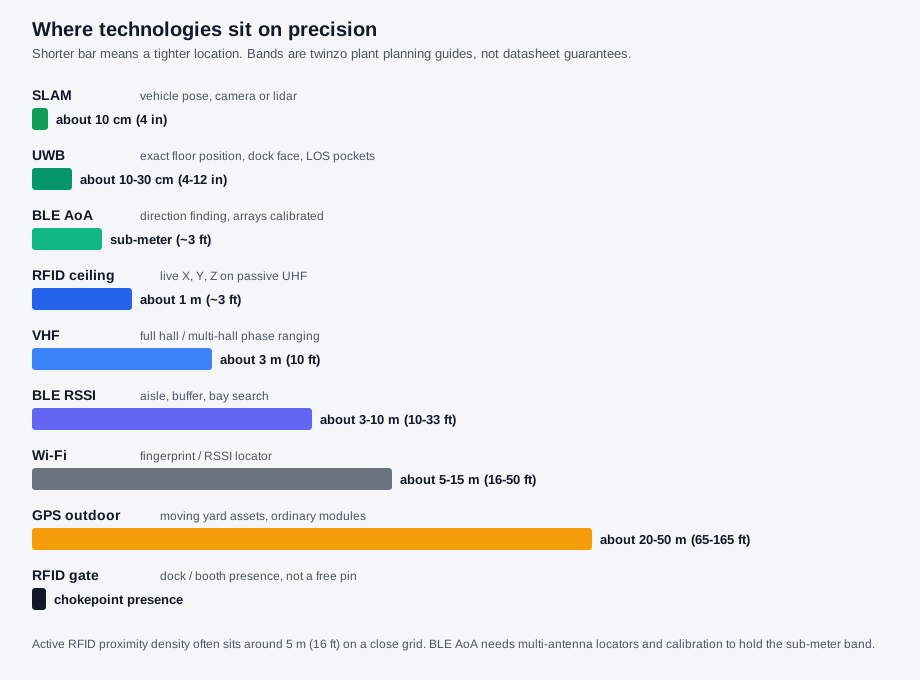
Aisle search often stops at medium precision. Online inventory management is a stricter job. If the plant wants every tagged cage, pallet, or tote on the map as a trusted stock location, not only "somewhere in this bay," exact floor position starts to matter. That is especially true in open staging, temporary parks, and floors without rack faces that naturally bound a search on foot. Sub-meter (~3 ft) is the band for that tighter pick path. It is not the default tax for every hunt-stop pilot.
When denser anchors sit only where cargo actually parks, and the tag list is limited to those loads, a cargo layout aimed at exact floor position can stay closer in scope to a medium-precision aisle layout than a full-hall high-precision build. The payoff is tighter place on the load, not a blanket upgrade of every aisle. Live inventory on the hall means ops opens the map and sees cargo position precise enough to pick without a second walk, even when the space is open. That is a different success test from ending the hunt in the right aisle. Radio choice and cost bands sit under compare RTLS technologies and start with the decision, not the technology.
What found must mean
For hunt-stop work, found is a location someone trusts at medium precision, about 1–3 m (3–10 ft), not a bin code that might be stale. For online inventory, found is tighter: the map location should be precise enough that the picker walks straight to the load in open space, not into the right bay and then still searches. If the map says the cage is in bay 12 and a person still cannot see it, coverage, tag attachment, precision band, or map fidelity failed. If the map is blank and WMS is sure, you are still buying walking. The hall drawing must match what drivers already know, or the location will be ignored. That map decision is under the map that logistics will trust. Buffer sit time after the find is under dwell time at the buffer that never shows in WMS.
Lean manufacturing programs already treat hunt and put-aside WIP as waste. A continuous place record turns that waste into evidence instead of another clipboard count. The same stack that ends the walk also feeds asset management questions about which returnable units keep leaving designed buffers.
How teams decide search is a tracking buy
1. Time five missing-cage hunts on one busy week - If minutes add up every shift, place is missing from the operating picture.
2. Separate hunt-stop from live inventory - Aisle find often needs medium precision around 1–3 m (3–10 ft). Trusted stock on the map in open spaces often needs exact floor position in the sub-meter (~3 ft) band.
3. Cost the exact-floor cargo layout against the medium plan, not against an unproven guess - With good coverage planning the delta can be small relative to the inventory benefit.
4. Prefer load tags when dwell hides material, mover tags when trucks hide capacity - Fund the question you ask most.
5. Require the find on a hall map people recognize - A coordinate without a trusted layout still forces a walk.
Material search on the live hall sits under internal logistics optimization and features. Production visibility on the same stack is under production monitoring. How a rollout is priced is on pricing.
Get in touch if you want to walk whether your next missing cage needs aisle-grade find, or live inventory precision on tagged cargo.