Safety cells and no-go enforcement on the live twin
Live no-go and safety cell rules on an operational digital twin turn restricted floor envelopes into shift events with a stored place-and-time record. They are not a substitute for certified machine guards.
What the benefit actually is
Floor paint, tape, and signs mark where people and movers should not go. Those marks do not create a notice when someone crosses them, so the shift rarely learns in time to stop the habit. The benefit of live enforcement is that tagged movers or people who enter a restricted envelope become a notice and a logged event on the same hall used for internal logistics and production monitoring. Supervisors see which restricted corners get crossed routinely, not only which corners carry a mark.
That is a safety and discipline benefit on the live layer. It is not a substitute for fixed guards, light curtains, or lockout. Machine-safety practice still sets how far a light curtain or similar protective device must sit from the hazard so motion stops in time. Digital geofencing makes policy observable. Certified safeguarding still owns stop-hazard timing. People-tracking go or no-go context sits under when RTLS makes sense for people. Forklift-side framing sits under when RTLS makes sense for forklifts.
Precision follows the envelope, not the brochure
Many logistics and safety envelopes work at medium precision around 1–3 m (3–10 ft). Aisle-scale presence is enough when the rule is "do not drive this pedestrian lane" or "stay out of this buffer wing." Coarse zone presence answers which part of the building or which chokepoint, and is a lower-accuracy job. Exact floor position at sub-meter (~3 ft) matters when the rule is a tight cell where "near the mark" is not the same as "on the mark." Drawing a 30 cm (12 in) digital rule and funding only medium precision is how the exact-position benefit fails.
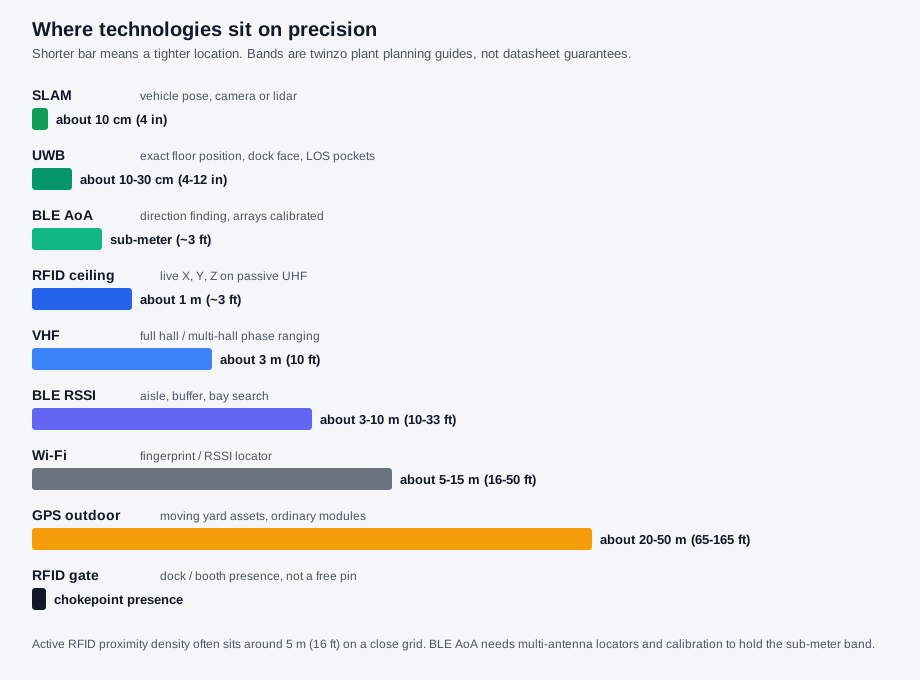
Match the real-time location system (RTLS) or equivalent location feed to the smallest envelope you will actually enforce. Do not treat every no-go as a sub-meter project. Keep medium-precision no-go and exact floor position as separate buys. The companion accuracy split for logistics track is under zone presence vs medium-precision logistics track.
What you buy when the rule is live
You buy faster intervention. A breach into a pedestrian lane or restricted bay can page the named owner while the shift can still coach or stop the habit, instead of waiting for a camera review or a near-miss write-up. Plants that already use RTLS geofencing for keep-out, slow, and pedestrian zones treat those notices as an awareness layer beside training and layout, not as the only control.
You also buy three equal operational-twin jobs on the same hall. Live enforcement supports shift reaction for safety and forklift tracking discipline. Breach entry and clear times land in the spatially oriented dataset under the map, so last week's shortcuts remain searchable. Area occurrence and correlation and causality analytics use that record to show which envelopes light up with dock surges, which movers repeat the cut, and which layout or training fixes actually moved the pattern. Funding alerts without the stored record and the pattern work leaves only noise.
Shared geometry helps. Safety cells and no-go polygons on the live twin should match the envelopes engineering already clash-checked, as in paying once for geometry three twin types can reuse. The twin does not invent safety policy. It makes the same policy measurable for logistics, continuous improvement, and safety owners together.
What it costs to earn that enforcement
Location fit is the hard cost. Medium-precision coverage for aisle-scale no-go is usually cheaper density than a sub-meter pocket around a tight cell. Mixing those jobs under one radio quote is how projects overspend or under-detect. Tags must stay on the assets and people the rule covers. A twin that only covers half the fleet will miss the habitual shortcut.
Alert design is the soft cost. Noisy fences teach people to ignore the twin. Start with a small set of true no-go and safety cells, clear owners, and escalation that matches severity. Temporary maintenance envelopes need owners who retire the rule when the work ends. Coverage dead zones and latency create false clears or late notices, so digital enforcement stays a visibility layer beside certified stops, not a replacement for them.
How the spend splits
1. Location fit for the envelope - Precision matched to cell size. Medium precision for many aisle and bay no-go rules. Exact floor position only where the mark demands it.
2. Twin rules and notices - Named zones on the operational hall, with twinzo or similar tools carrying the same map as logistics and production.
3. Record and pattern ownership - Who acts on a live breach, who reviews area occurrence monthly, and how layout or training owns the fix when correlation keeps pointing at the same corner.
How to decide if this benefit is yours
1. List floor rules that only work when someone is watching - Those are candidates for live enforcement on tagged movers or people.
2. Match precision to the smallest cell you will enforce - If the digital zone is tighter than your location band, fix precision first or widen the digital zone honestly.
3. Fund the stored record with the live alert - Breach history for the spatially oriented dataset and correlation work is part of the same buy, not a later add-on.
4. Review breach patterns with safety and logistics together - Layout, mirrors, coaching, and process changes own different fixes. A twin that only pages and never redesigns becomes alarm fatigue.
How the operational type hosts these rules sits under operational digital twins show the shift. Capability depth is on the features overview. How a rollout is priced is on pricing. Match the digital zone to the floor-mark size, or people will distrust both the mark and the twin.
Get in touch if you want to walk which restricted envelopes on your floor are worth live enforcement on a shared hall twin.