Outdoor yard GPS vs indoor hall track
Outdoor yard GPS and indoor hall track answer different place questions. One radio rarely owns both, and the dock handoff is where logistics tracking usually breaks.
What each stream is built to answer
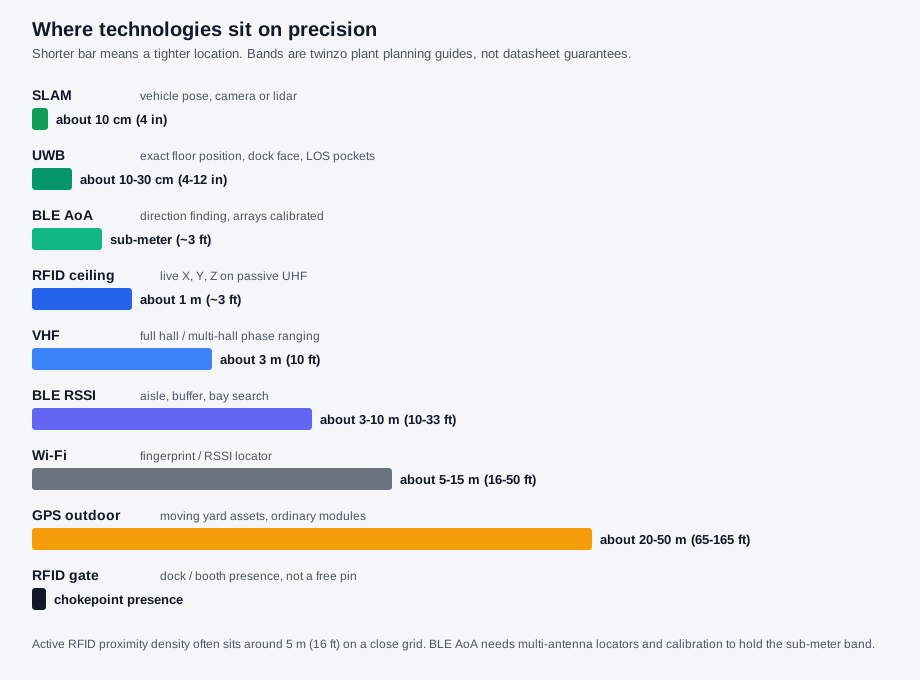
GPS (and the wider GNSS family) is the outdoor peer in a real-time location system (RTLS) stack. It answers campus and yard questions with sky view: which trailer sits in which lot, which yard tractor is on the ring road, whether a vehicle approached the dock face from outside. Brochure and phone-app numbers often quote about 3–5 m (10–16 ft) outdoors. On moving plant-yard assets with ordinary tracker modules, reported locations commonly jump about 20–50 m (65–165 ft). That band is still enough for coarse lot and gate presence when the team accepts wander on the order of tens of meters.
Inside a steel-roofed hall those satellite signals drop or lie. Aisle search, free forklift claim, buffer dwell, and most internal logistics work need an indoor positioning stream, typically at medium precision around 1–3 m (3–10 ft). Coarse wing or chokepoint presence is a different, lower-accuracy indoor job. Exact floor position at a mark is a third job. Accuracy language for the indoor half sits under zone presence vs medium-precision logistics track. GPS as an RTLS peer is under GPS for RTLS.
Why one campus map is not one location job
Yard GPS alone does not track movers and loads after they cross the door. Indoor tags alone do not explain why a trailer sat outside before the load entered the hall. Plants that run both scopes need two success tests, not one slide that pretends one radio covers the whole site. Treating the campus as one coarse zone hides which wait burned time: gate dwell, dock apron wait, or indoor buffer dwell.
Asset tracking and forklift tracking inside the building sit on the indoor stream. Outdoor trailer and yard-tractor presence sit on GPS or a yard map. Industrial fleet management that only watches the lot still misses the free forklift in the aisle. The reverse is also true: a dense hall grid does not locate a trailer three rows deep in the gravel lot.
What the dock handoff must name
Handoff is the rule that turns outdoor presence into an indoor logistics object as a trailer arrives, a cage or pallet crosses the dock, and an indoor mover takes the load. Yard management owns gates, appointments, trailer states, and dock-door assignment. Hall logistics tracking owns movers and loads after they are inside. twinzo's indoor hall can show the internal side. The yard system still owns the perimeter story unless the plant deliberately bridges identities at the door.
The handoff must name three facts in plain language: which outdoor identity (trailer, container, or advance ship notice (ASN)) maps to which indoor object (cage, stillage, or pallet ID), where the coverage boundary sits (gate geofence, dock face, or apron edge), and who records the custody change when the outdoor stream ends and the indoor stream starts. Object choice inside the hall remains under tagging the mover vs tagging the material. When the same physical tag must stay visible through the wall without a second radio, that continuity decision sits under indoor and outdoor on the same move.
Two true screens that still leave a gap
A yard board can correctly show a trailer docked while the line still waits. Indoor tracking never saw the load when the cage sat on the dock apron outside hall coverage, or when identity never crossed from trailer ID to cage ID. Both screens can be true. The missing fact is the handoff rule, not another accuracy claim on either radio.
Do not fund a hall AOS (commonly known as FGS) pilot with yard language, or a YMS project with aisle-find promises. Indoor empty travel and free-truck claim still need the hall stream under loaded vs empty travel you can prove and where the free forklift actually is. WMS receipt status and outdoor GPS arrival are also not substitutes for that indoor place record.
Keep outdoor and indoor waits in one place-and-time record
When both streams exist, stored places still matter equally with live search. Outdoor dwell at the gate and indoor dwell in the buffer are different waits. Keeping them in a spatially oriented dataset with clear area names gives the plant a spatiotemporal record under the live map. Live logistics uses that map for search and move decisions. The same record feeds correlation and causality analytics that ask which yard delays keep preceding indoor starves, without mixing the two clocks into one fake campus zone.
Those three jobs sit on equal footing: shift operations on the hall and yard views, the stored place-and-time dataset those views write, and the pattern work that reads the dataset later. A program that only funds outdoor arrival alerts, or only funds aisle find, has not finished the operating rule across the door.
How teams keep the scopes honest
1. Write separate success tests for yard arrival and hall find - One radio rarely passes both. Name the outdoor question (which lot, which gate) and the indoor question (which aisle or buffer) before any vendor name.
2. Name the dock as the handoff, not the whole campus as one zone - Blunt geometry hides the wait. Put the geofence or coverage edge on a map both owners can point to.
3. Keep YMS purchase language off the indoor AOS (commonly known as FGS) pilot - Different owners, different proofs. Trailer appointment logic does not prove free-forklift claim.
4. Bridge identity only for loads that must stay continuous across the door - Not every trailer needs an indoor tag story. Bridge the IDs that production actually waits on.
Indoor logistics tracking sits under internal logistics optimization and the features overview. Production waits inside the hall are under production monitoring. Pricing is under pricing.
Get in touch if you want to walk where your outdoor yard story should stop and your indoor hall track should start.