Indoor and outdoor on the same move
When payback depends on one continuous move across the dock door, indoor and outdoor cannot be separate maps. The same tag needs one location stream on both sides of the wall.
What continuous indoor and outdoor coverage means
A continuous indoor and outdoor move is a single physical object that must stay findable inside a hall and on the yard or between buildings without swapping technology or identity at the door. The object is usually a forklift, tugger, cage, or returnable that leaves coverage, crosses outdoor ground, and re-enters another roof. The success test is one trusted location for that tag across the boundary. Two separate maps can each look correct while the crossing interval still has no continuous place record.
That job is different from coarse outdoor lot presence alone, and different from indoor aisle search alone. It is also different from a deliberate handoff where outdoor trailer identity stops and a new indoor load identity starts. The handoff pattern, when you keep two streams on purpose, is under outdoor yard GPS vs indoor hall track. This page settles the opposite case: the same tag must remain visible through the wall.
Why VHF is the combination for that move
VHF phase ranging is the indoor and outdoor combination in a real-time location system (RTLS) stack for that continuity job. Fixed gateways transmit low-frequency carriers. The tracker on the vehicle, person, or asset measures phase, separates the direct path from reflections, and computes its own position on the device. The location stream continues as the asset passes through building fabric and into the yard. Plants do not insert a second radio family at every dock for that tag.
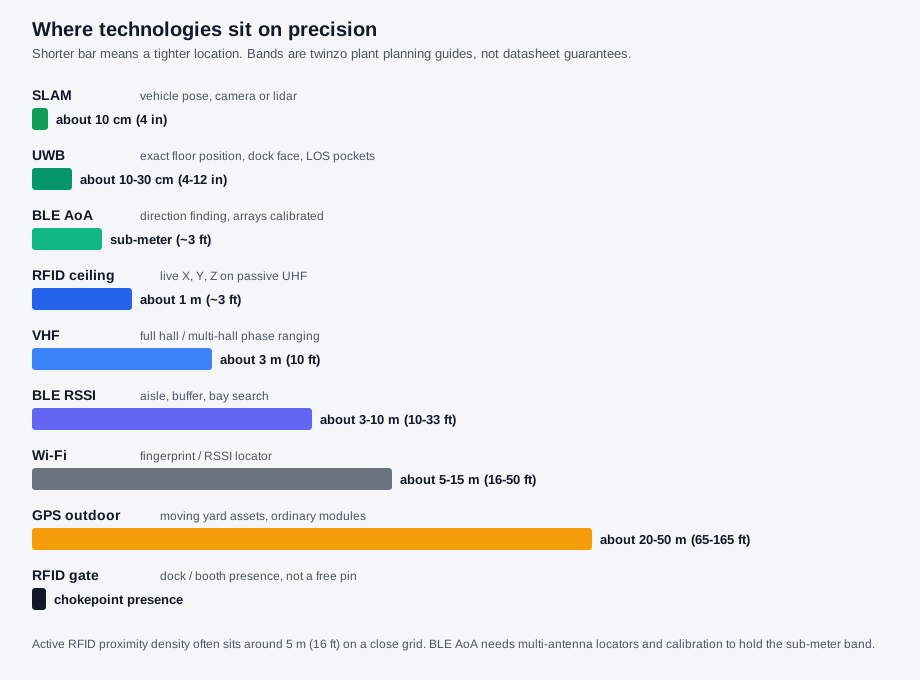
About 3 m (10 ft) is the realistic planning accuracy for this job. Four antennas across roughly 40,000 m² (about 430,000 ft²) is the documented starting guide in automotive plant planning, then a pilot on the real ground with inventory in place. That band is medium-precision campus and hall search, not exact floor position on a mark. How the method works end to end is in VHF for RTLS. How a campus of different buildings uses VHF as the sparse site layer is in different buildings across two square kilometres.
What GPS is still for
GPS (and the wider GNSS family) answers a yard or campus road that never needs the same tag indoors. Which trailer sits in which lot, which yard tractor is on the ring road, and whether a vehicle approached the dock face from outside are outdoor questions with sky view. Brochure figures often quote about 3–5 m (10–16 ft) outdoors. On moving plant-yard assets with ordinary tracker modules, reported locations commonly wander about 20–50 m (65–165 ft). That band can still be enough for coarse lot and gate presence when the team accepts that wander.
Under a steel roof those satellite signals drop or lie. Industry practice therefore keeps GNSS for open yards and uses a separate indoor positioning stream for hall work. Buying GPS for the yard and a separate indoor stack is a fair pair when identities are allowed to change at the door. It is a poor pair when the payback depends on one continuous move on one tag. A compact hall with no outdoor move does not buy VHF because a larger campus did. That hall stays on the small-hall combination in small fleet in a small hall. Frequency licensing is a VHF cost the indoor-only hall never has to carry.
When continuity also fills the dataset and the analytics
One stream through the door is cleaner for live internal logistics search and forklift tracking across halls and yards. The same locations also write a continuous spatially oriented dataset: place and time for the tagged mover on both sides of the wall, without stitching two clocks at the dock. Correlation and causality analytics can then ask which yard waits keep preceding an indoor starve, because the outdoor dwell and the indoor dwell sit in one place-and-time record.
Those three uses sit on equal footing. Shift operations use the live map for find and move decisions. Continuous improvement and management read the stored dataset. Pattern and root-cause work read the same record later. A program that only funds outdoor arrival alerts, or only funds aisle find, has not finished the operating rule for a move that crosses the wall. Live use of that map in twinzo sits under internal logistics optimization and production monitoring.
When VHF still pays back within six months
VHF pays when many assets share a few gateways across halls and yards. The cost sits on trackers and a sparse gateway set, plus the national licence to transmit on the approved VHF band. The investment does not pay back within six months when a site installs it for a handful of indoor-only trucks, or when a campus installs a dense indoor grid outdoors and calls the gaps a software issue. How to judge that ROI against the right combination is in the six-month return depends on the combination. Licensing, survey, and mount labour belong on the sheet in what to include when calculating RTLS ROI before anyone claims a six-month return.
How teams decide VHF belongs on this move
1. List assets that must be visible both inside and outside on one tag - If the list is empty, keep GPS for the yard and the indoor combination for the hall. Asset tracking and industrial fleet management still need separate success tests for outdoor-only objects and indoor-only objects.
2. Confirm about 3 m (10 ft) is enough for those moves - Exact floor position at a mark is a different, smaller zone with a tighter technology inside the building that needs it. VHF is the continuity layer, not a replacement for every aisle decision.
3. Include national frequency approval in the cost before you buy hardware - Survey antenna height and gateway count on your layout. Without that approval you cannot claim ROI within six months.
4. Keep tighter indoor technologies inside the building that needs them - Medium-precision aisle work and exact floor position stay local. Continuity across the door stays on the sparse VHF layer when the same tag must cross.
What the product can do with those locations is on the features overview. How a rollout is priced is on pricing. Get in touch if you want to walk through whether your dock-crossing moves need one continuous stream or a deliberate outdoor-to-indoor handoff.