Each combination keeps its own six-month test
A location combination that paid back in six months on one site is not a guarantee for the next roof. Every later building and every later layer still needs its own six-month test.
What a separate six-month test means
The shared rule is ROI within six months. The euro (dollar) amount is not shared. Hall size, fleet size, and what must stay visible pick a real-time location system (RTLS) stack for that site only. Which stack fits which site is settled in the six-month return depends on the combination. This page settles the next decision: after one combination passes, the next building, yard move, cage program, or tight mark still needs its own priced sheet.
Industry multi-site practice matches that split. Finance needs an answer for each site, not an average taken from the strongest pilot. Benefits that depended on roof height, fleet count, control-system readiness, or who owns the operating budget do not travel automatically. Under phased approval, finance fully prices the next wave and sets a pass or fail date before the rest of the network inherits the first site's numbers.
Why neighbouring euros fail the next sheet
Documented sites already show how far the amounts sit apart. A 15,000 m² (about 161,000 ft²) logistics center invested €3,500 (about $3,850) in logistics RTLS and recorded €11,000 (about $12,100) of year-one OPEX saved. A 30,000 m² (about 323,000 ft²) automotive Tier-2 hall invested €120,000 (about $132,000) and recorded €960,000 (about $1,056,000) of year-one OPEX saved after the fleet fell from 36 to 20 forklifts. A 100,000 m² (about 1.08 million ft²) roof and a 2 km² (about 494 acres) campus of different buildings can also pay back within six months. They do it on their own combinations. One site's invoice is not the other site's budget.
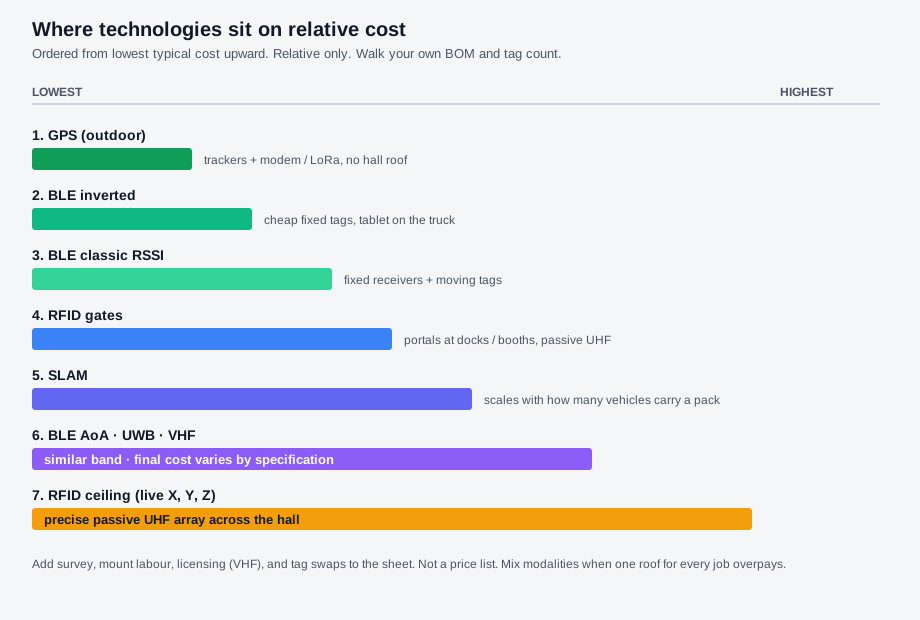
Upkeep follows the combination you installed, not the neighbour's quote. Inverted BLE means beacons and tablets. A pack on each truck means a pack per vehicle. A dense grid means anchor mounts and cable. VHF means licensed gateways and trackers that already cover indoors and outdoors. Batteries, spares, firmware labour, and the licence that scales with positions arrive after go-live. A €3,500 (about $3,850) pilot can look finished in year one and still burn through its €11,000 (about $12,100) year-one operating save if batteries, spares, firmware labour, and licences were left off the sheet. The checklist sits under what to include when calculating RTLS ROI.
What the next layer is allowed to buy
Extend with a new test, not by copying the neighbouring site. A yard move that must stay on the same tag uses VHF, described in indoor and outdoor on the same move. Cages and other loads are a separate purchase, described in tracking material is a separate purchase. A dock mark that medium-precision location around 1–3 m (3–10 ft) cannot settle is a small exact-position zone, described in exact floor position only where the mark matters. Each layer has its own spend, and each one has to pay that spend back within six months.
Calls, patrol, and line micro-stops that were never a location problem stay on AOS (commonly known as FGS), as described in calls and micro-stops before a location grid. Adding a roof grid to a finished pull project is a new test. It does not inherit the €5,080,000 (about $5,588,000) production figure from the documented white-goods AOS case. Do not blend AOS production euros with an RTLS fleet cut in one payback cell.
What still grows after each pass
Every combination that passes still writes the spatially oriented dataset for the places it covers. Live internal logistics and forklift tracking read free capacity, empty corridors, and fleet load on a hall people trust. The same place-and-time record is the dataset continuous improvement keeps after the project sponsor leaves. Correlation and causality analytics asks which pairings keep preceding a starve or an empty-travel loop. Those three uses sit on equal footing. They grow when you add a layer that earned its own payback. They do not grow when you copy hardware into a building that did not need it.
The live view for shift work sits under internal logistics optimization and production monitoring. The same stack holds the dataset and the correlation work. It is not a logistics view with history added as an afterthought.
How teams run the next test
1. Name the building, the fleet, and the move this layer must see - Small hall, one large roof, the road between buildings, cages on that path, or a mark that needs exact floor position. Name the asset tracking objects too, so the sheet does not silently inherit the neighbour's tag count.
2. Price only that combination, including upkeep through the month the investment should have paid back - Leave the neighbouring site's numbers in that site's own file. A lean manufacturing rollout that copies the pilot stack without that sheet treats the first site as a network template.
3. Judge pass or fail on this layer's operating save or recovered minutes - Keep pull production euros and RTLS fleet OPEX on separate sheets.
4. Open the next layer only after this one has passed - What the product can do is on the features overview. How a rollout is priced is on pricing.
Get in touch if the next building is about to inherit a budget that the last building earned for a different job.