Different buildings across two square kilometres
Across a multi-building campus of about 2 km² (about 494 acres), do not copy one building quote under every roof. Each hall needs its own indoor combination, plus a sparse layer for moves that leave those walls.
What this site shape actually is
Buildings on one campus rarely share the same area, ceiling height, or truck count. One address may be a 100,000 m² (about 1.08 million ft²) production hall. Another may be a compact shed. Roads, yards, and dock approaches sit between them. Industry deployments on large industrial campuses treat that mix as a hybrid job: indoor radios sized to each hall, plus outdoor or through-wall continuity for the assets that leave a door, all normalized onto one map.
A single purchase order that carpets the densest hall's locator grid across every roof still goes blind outdoors, and it still overspends mounts where traffic never justified them. The campus decision is therefore two layers: indoor combinations that stay local, and a site layer for the moves that cross buildings.
Why each building keeps its own indoor combination
Indoor real-time location system (RTLS) cost follows floor area when anchors or receivers cover the roof, and it follows vehicle count when tags and tablets ride on the trucks. A compact shed with a short fleet follows small fleet in a small hall. A large roof with many forklifts follows one large building and a large fleet. A large roof with few trucks follows small fleet in a large hall. Those pages settle different arithmetic. They are not three names for the same bill of materials.
Copying the 100,000 m² (about 1.08 million ft²) shared-grid template into every address spends capital on mounts that never see the traffic that paid for them. That copied spend fails the six-month ROI test even when the largest hall could have passed on its own numbers. Medium-precision location, about 1–3 m (3–10 ft), remains the usual indoor band for aisle and fleet work inside each building that needs it. Exact floor position stays only where a mark requires it.
The continuity layer across halls and yards
The campus-wide job is the move that leaves a building: a tugger, forklift, person, or tagged returnable that must stay visible through a wall and into the yard. That is not a second copy of the densest indoor grid. It is a campus continuity layer.
VHF phase ranging is built for full halls, several halls, and the outdoor ground between them on one location stream. A few gateways cover a hall without a locator in every aisle. In documented automotive planning, about 3 m (10 ft) with four antennas across roughly 40,000 m² (about 430,000 ft²) is a realistic starting guide, then a pilot on the real layout. Low-frequency carriers penetrate building fabric, so people and vehicles can move through walls and into the yard without a new technology at every door. How the tracker computes that position is described in VHF for RTLS. The same continuity case, when the payback hangs on one tag indoors and outdoors, is described in indoor and outdoor on the same move.
National frequency approval is part of the cost, not a side note, and the hardware is a specialist stack. About 3 m (10 ft) is a planning baseline for hall and campus work, not exact floor position. Put licensing, survey, and mounts on the sheet in what to include when calculating RTLS ROI before you claim payback within six months. GPS remains the yard tool when identities are allowed to change at the door. It is the wrong substitute when the same asset must keep one continuous location through the wall.
How the campus still faces a six-month payback test
The campus passes a six-month payback test when each building funds only the combination its size and fleet can support, and a sparse continuity layer is shared by the assets that cross the 2 km² (about 494 acres). A high count of trucks, tuggers, and returnables is what makes a small gateway set rational. There is no published euro case that labels a 2 km² (about 494 acres) site as a measured twinzo result. The test is the same one used on measured halls: year-one operating saving has to repay this site's own spend within six months. How that test works is described in the six-month return depends on the combination. Each later layer keeps its own test, as described in each combination keeps its own six-month test.
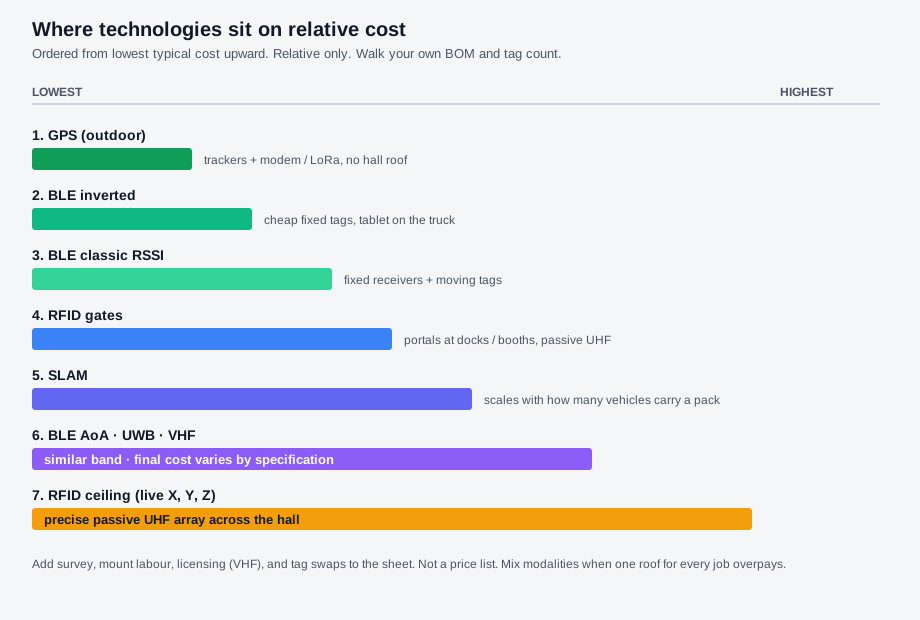
Industry practice on yard-scale sites points the same way: forcing one radio across every zone raises infrastructure euros without matching operating savings. Match radio density to the search and fleet job inside each building, keep continuity sparse across the roads, and judge asset tracking spend against the empty travel and search time that combination actually removes.
One twin for halls, roads, and later analytics
One operational digital twin holds the buildings and the roads so a delay on the road sits next to a starve in a hall on the same clock. That live view supports shift internal logistics and industrial fleet management on the campus map. The same locations fill a spatially oriented dataset: the stored place-and-time record under the live view that continuous improvement and later models need. Correlation and causality analytics then asks which yard waits keep preceding an indoor stop, without stitching two clocks at every door.
Those three jobs sit on equal footing. Cutting empty travel is not a better reason to keep the map than keeping the spatiotemporal record or reading hall-wide causes. A smart manufacturing program that only funds the densest roof and leaves roads untracked still breaks the campus record at the first outdoor move. Live logistics work lands in internal logistics optimization. Production-side reads of the same twin sit under production monitoring.
How teams split the purchase
1. List each building's area and fleet before you pick a technology - Different buildings stay different. Do not start from the largest hall's quote.
2. Fund a continuity layer for moves that cross indoors and outdoors - VHF when the same tag must stay visible through the wall. GPS for yard-only identities that never enter under roof on that tag.
3. Add a tighter indoor technology only inside the building whose decision needs it - Medium precision for aisles and fleet, or exact floor position for a mark, not both everywhere.
4. Give the campus one ROI sheet made of those lines, and require payback within six months on this site's spend - Refuse the biggest hall's quote repeated across two square kilometres. What the product can do is on the features overview. How a rollout is priced is on pricing.
Get in touch if your campus is being priced as one building repeated across two square kilometres.