Clarify the business question first
Before you pick a twin or an AI stack, name one decision that already costs the shift time or money. Start there, or the program buys dashboards before anyone has something they will act on.
What a usable business question looks like
A usable question names an object, a place scale, and a cost the plant already tracks. Examples that survive a finance review are concrete: whether material moves create micro-stops beside a named buffer, whether the forklift fleet is unbalanced across shifts, or whether response time to line calls stays too long. The question must map to a KPI or hour rate someone already believes. A slide that only promises smarter AI or a full smart factory stack is not a question yet.
That gate belongs at the front of the path on purpose. Industry maturity models for digital twins usually put monitoring and live sync before predictive claims for the same reason: without a named loss and a place to observe it, later models inherit noise. Narrowing the question is also how a two-to-four-week zone pilot stays a learn cost instead of a plant-wide hypothesis. That learn economics sits under what a two-to-four-week hall pilot actually costs to learn.
Trustworthy spatial data before any model
No model layer repairs incomplete or ungoverned feeds. An operational digital twin sits above systems of record. It ingests locations from a real-time location system (RTLS) where needed, plus signals from MES, ERP, WMS, SCADA, and IoT, without replacing those apps. Locations of forklifts, people, and materials land on a hall people recognize so each event carries place and time.
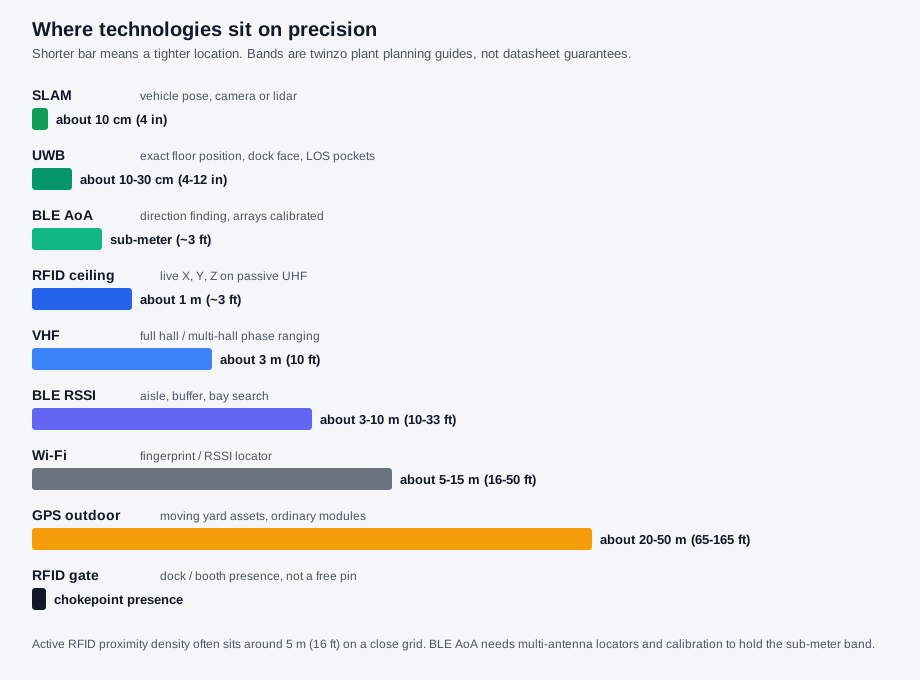
Accuracy must match the question, not a brochure. Medium precision around 1–3 m (3–10 ft) is usually enough for aisle, buffer, and bay logistics work, including many no-go checks. Coarse zone presence answers which wing or gate. Sub-meter (~3 ft) matters when the job needs exact floor position on a mark. Historical replay, spaghetti diagrams, and heat maps let the team verify that the twin matches the hall before anyone trains a model. Role-based access, audit logging, and optional on-premises deployment keep data governance under plant control. Only after this layer is stable does the spatially oriented dataset become useful for later analysis.
Run a narrow, governed pilot
Typical pilots last two to four weeks. Limit scope to one zone, a defined set of assets, and success metrics that map directly back to the original business question. Use the same live 3D views and reports the team will rely on later. Keep governance light but real: who can see what, what is logged, and when the pilot ends. The goal is not a polished AI demo. It is proof that the operational picture is accurate and that someone will act on it.
Pass means one named waste, one owner, and one measurement that was blind before the pilot. If the picture and the floor disagree, fix that first. Discovering the mismatch after a campus purchase is not a cheap finding. Ownership before the tech catalog is the related gate under digital lean needs a waste owner before the tech catalog.
Measure against the baseline you already have
After the pilot, compare movement patterns, dwell times, and utilization against the data the twin already collected on that zone. Document what changed in language that shift supervisors trust. If the numbers move and the process stays disciplined, the foundation is ready. If they do not, fix the data or the process before adding complexity.
Keep three equal jobs in view while you measure. Acting on live internal logistics is only one. The same tracks must feed the spatially oriented dataset under the live view. Later correlation and causality analytics use that record when the same place-and-time pairing keeps preceding a stop. A pilot that only proves the map looks familiar and never stores the events has not finished the learn. That is useful smart manufacturing and lean manufacturing practice, not a reason to widen the buy early.
Scale only when the foundation holds
With a trusted operational twin, the same spatially oriented dataset can later support correlation exploration or a predictive twin. Those AI capabilities remain later uses of clean, governed, location-aware history. Rushing them earlier relocates the cost into a larger invoice and a thinner record. The sequence is deliberate: each stage builds the discipline the next one assumes is already present. How prediction waits on stored history is under predictive digital twins wait on stored history. Why the spatial layer itself is the spend before the model is under spatial data has to exist before the model does anything useful.
twinzo ships the operational layer today: live locations and plant signals on a hall people trust, with the dataset underneath that later models need. That picture already supports internal logistics optimization and production monitoring on this shift. Capability detail lives on the features overview. Start with one question this quarter can measure. Get in touch if you want to size that question on your own facility model before any model or plant-wide buy.