BLE for RTLS: three ways to get a floor location
If the floor job is aisle, buffer, or fleet search at about 1–3 m (3–10 ft), Bluetooth Low Energy (BLE) is often the RTLS radio plants shortlist first. This page covers the three BLE builds, what they do well, and where they break.
What BLE is
BLE is a low-power 2.4 GHz radio used for indoor RTLS, indoor positioning, and asset tracking. Tags, phones, and tablets already speak it. Classic and inverted builds that score RSSI aim for the medium-precision band of about 1–3 m (3–10 ft) when coverage is honest. In heavy metal halls the same builds often sit wider, about 3–10 m (10–33 ft), still useful for aisle search but not the same band as a clean medium-precision layout. That medium-precision band answers which aisle, bay, or buffer holds a mover or load. It is not zone presence, which only names a wing or chokepoint. It is also not exact floor position on a mark. Angle of Arrival (AoA) can tighten BLE toward sub-meter (~3 ft) when multi-antenna arrays, survey, and line of sight hold.
BLE is one technology family among peers. Inside BLE, topology still matters: fixed receivers, inverted tablets, or direction-finding arrays. Match the floor job to the technology first, then the build inside it. The decision order sits under start with the decision, not the technology. The wider menu is in RTLS technologies out there.
How BLE gets a location
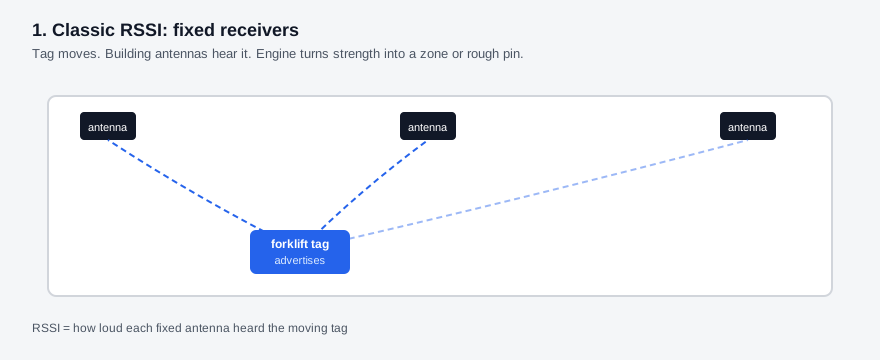
1. Classic RSSI with fixed receivers - Tags or beacons ride on the truck, cage, badge, or tote and advertise. Fixed antennas hear them and score RSSI. The location engine turns strength samples into a bay-scale location or a rough coordinate. Infrastructure sits on the building. Movers carry the cheap radio. This layout fits halls that must tag many unpowered loads without putting a calculator on every asset.
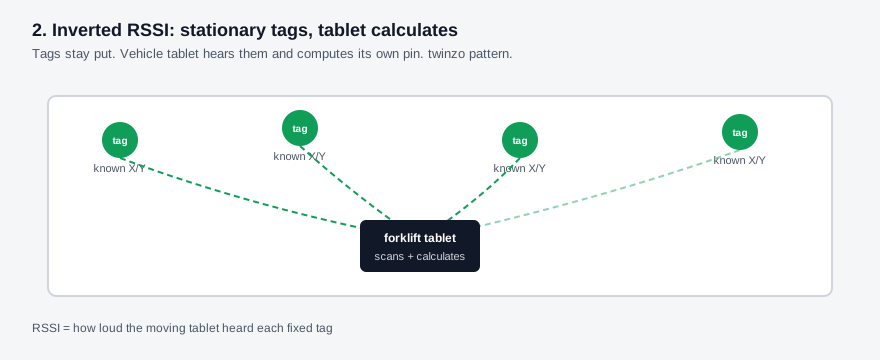
2. Inverted RSSI: stationary tags, tablet calculates - Cheap tags stay fixed as known anchors. A forklift tablet or phone scans them, measures RSSI, and calculates its own location. The vehicle is the locator. This build is usually strong value for forklift tracking and powered-crew paths on the twin used for internal logistics, and for travel review in maintenance optimization with RTLS. It needs power on the tracked object. Cold cages and pallets cannot host the calculator.
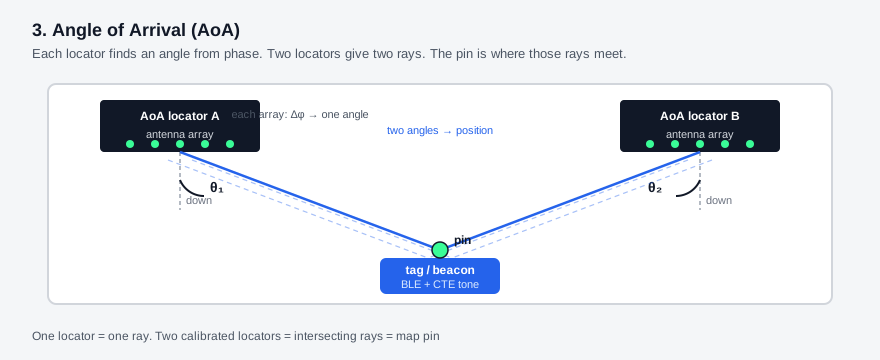
3. Angle of Arrival (AoA) - A multi-antenna locator measures the incoming angle, not only loudness. Bluetooth 5.1 direction finding made this a standard option inside the BLE family. AoA can tighten location when arrays and line of sight hold. Arrays cost more than simple RSSI gateways and still fight metal bounce and multipath.
Strengths
Cheap tags and multi-year battery life are realistic at honest advertising intervals. Phones and tablets the plant already buys can join the stack as scanners or vehicle locators. That keeps dedicated locator spend on the powered movers that need a live location, while classic fixed receivers stay available when many unpowered loads need a cheap tag.
Medium-precision BLE fits aisle search, buffer occupancy, path replay, fleet utilization, and empty travel work when about 1–3 m (3–10 ft) is enough. Many no-go zones also run at that band when aisle-scale presence is the rule. Inverted RSSI keeps dedicated locator spend low on powered forklifts and crews. Classic RSSI scales when many unpowered loads need a tag without a tablet on each one. Both builds feed the same hall map used for asset management and industrial fleet management once locations land in one twin.
Weaknesses
RSSI is loudness, not a clean meter stick. Metal racking, body shadowing, Wi-Fi congestion on the same 2.4 GHz band, and multipath make strength jump, so the engine can be precise about the wrong place. Why that conversion fails on a metal floor is explained in RSSI is signal strength, not distance.
Inverted RSSI needs a powered device that can scan honestly during travel. OEM firmware that throttles BLE scan looks like a coverage hole even when beacons are present (see Android firmware limits on BLE scan). AoA needs specialised arrays, survey, and cleaner geometry than a simple RSSI gateway. Dense classic grids still cost cabling, power, and tag upkeep. Put that labour on the payback sheet in what to include when calculating RTLS ROI.
When BLE fits
1. Name the shift question - Bay search, continuous forklift path, crew response travel, buffer occupancy, or aisle-scale no-go. If the answer can be wrong by about 1–3 m (3–10 ft) and still work, BLE is in range. If you only need wing or gate presence, that is a coarser job than a medium-precision BLE grid.
2. Check power on the asset - Powered trucks and phones lean inverted RSSI. Unpowered cages and totes lean classic tags on fixed receivers. Choose AoA inside BLE when the same radio family must tighten toward sub-meter (~3 ft) and the hall can support arrays.
3. Pick the BLE build, then land one map - Classic, inverted, or AoA. Then put the stream on one digital twin for logistics and production monitoring. Equal peer deep dives for other radios sit in RTLS technologies out there, and side-by-side precision, battery, and cost bands sit under compare RTLS technologies. Definitions start at what is RTLS. Product capabilities are on the features overview.
Pick BLE when its strengths match the job and its weaknesses are acceptable on your floor. Get in touch if you want to walk that choice on your own facility model.