Battery life for RTLS: power, passives, and sample rate
Tag battery life and update rate are the same decision. Raise how often a tag reports and you shorten how long it lasts, and that trade-off decides whether spaghetti charts and live maps stay honest on a real-time location system (RTLS).
What battery life means on the plant floor
Accuracy slides do not keep tags alive. The plant still has to swap cells, run powered devices, or use tags with no cell at all. A stack that needs frequent battery changes across thousands of returnables fails in operations even when the location math is fine. A stack that lasts years but only reports every fifteen minutes fails internal logistics analytics even when the batteries look healthy. Put power and update rate on the same scorecard as coverage and accuracy when you shortlist options in RTLS technologies out there.
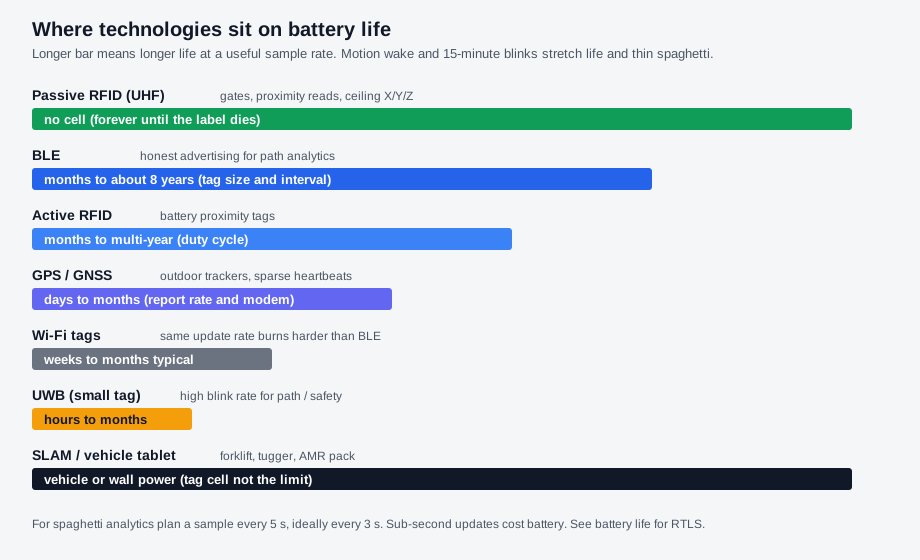
Tag size, chemistry, transmit current, and how often the radio wakes set the range. Depending on the technology and the form factor, battery life can run from hours to about eight years. Many coin-cell chemistries still cap practical life around five years even when the radio math looks longer. Purely passive RFID tags have no cell. They harvest energy from the reader field for the moment of the read. That is continuous service life until the label is destroyed, not an eight-year datasheet claim.
Passive, battery, and powered builds
1. Passive - Classic passive RFID has no onboard battery. The reader powers the tag for the read. Gates, many proximity layouts, and ceiling RFID builds that report live X, Y, and Z all use passive UHF tags. Battery-assisted passive tags still carry a cell for the chip or sensors, yet they backscatter like passives rather than running their own transmitter. Active RFID proximity is a different build: battery tags with their own radio. Ask which RFID power model you are buying before you treat every RFID quote as the same ops load.
2. Battery tags - BLE beacons, many active RFID tags, small UWB tags, and some campus trackers run on coin cells or small packs. Life stretches when the radio sleeps and packets are rare. Life collapses when the radio transmits often, the antenna is small, or the cell is tiny for a thin badge. Multi-year BLE life at an honest advertising interval is common. Published beacon lifetime tables often show months at roughly 100 ms advertising and several years once the interval moves into the multi-second band, with chemistry and cell size still in charge. High blink-rate UWB on a small cell commonly sits in hours to months. The same UWB family at slower refresh, larger cells, or motion-gated sleep can reach years. Neither pattern ranks one radio above another. Both name a power budget inside that family.
3. Powered devices - Forklift tablets, vehicle gateways, SLAM packs, and many Wi-Fi clients pull from vehicle or wall power. Tag battery life stops being the constraint. Device uptime, Wi-Fi association, and firmware scan limits take over instead. Outdoor GPS trackers sit between the two models: a pack must last days or months at a chosen report rate over LoRaWAN or LTE.
How stacks stretch life, and what analytics lose
Energy-heavy radios forced into small form factors often stretch life by cutting duty cycle. An accelerometer wakes the radio only on move. A schedule sends a blink once every fifteen minutes, once an hour, or only after motion. Those designs look healthy on a battery lifetime claim. On the twin they create thin streams for analytics.
Idle cages vanish from heat maps. Empty rounds look shorter than they were. Dwell understates parking. Spaghetti charts break into dots instead of paths. A bay search job under asset tracking can survive rare blinks when presence is enough. Shift balancing, utilization, continuous path replay, and industrial fleet management that depends on those paths all fail when samples stay that sparse. Beware any RFQ line that buys multi-year life by silently cutting the sample rate below what your analytics need. Hidden swap labour and thin data both belong on the sheet in what to include when calculating RTLS ROI.
Sample rates that spaghetti and analytics need
For spaghetti charts and movement analytics, plan a position sample at least every 5 seconds, and ideally at least every 3 seconds. That cadence keeps aisle turns, short stops, and empty loops visible on the hall model. Stacks built for tight motion can deliver sub-second updates when the job needs them, such as safety cells, fast vehicles, or dense replay. Sub-second reporting has a direct cost in tag battery life, gateway load, or both.
Match the rate to the decision. Yard heartbeats over GPS can sit at minutes when the question is lot presence. Indoor forklift tracking for logistics optimization should not. If a quote only hits multi-year life by sampling once per quarter-hour, treat that as a different product than continuous RTLS analytics, even when the radio family sounds the same. Decision order for the job itself sits under start with the decision, not the technology.
How teams choose without drowning in datasheets
1. Name the analytics job - Search only, gate presence, or continuous path and utilization. Presence can live on rare events or passive RFID. Spaghetti and shift analytics need the 3–5 second floor, or faster.
2. Name the power model - Passive, battery tag, or powered device. Count how many units need cell swaps per year at the update rate you actually require, not the brochure rate.
3. Reject silent duty-cycling - Ask whether life claims assume motion wake, fifteen-minute blinks, or continuous advertising. Put the answer next to the sample-rate requirement before you sign.
4. Land one map with honest samples - Put the stream on one digital twin for logistics and production monitoring. Peer technology pages for each radio sit under RTLS technologies out there. Relative power bands across families sit in compare RTLS technologies. Definitions start at what is RTLS. Product capabilities are on the features overview.
Pick the power model and sample rate together. Accuracy without samples you can trust will not support path analytics or the investment case. Get in touch if you want to walk battery and update-rate choices on your own facility model.