Blog

Getting started with RTLS

Guide to position technologies

  • Tomas Vojtek

  • November 15, 2024

twinzo logistics analytics on a phone
Getting started with RTLS

Introduction to RTLS Technologies

Location technologies can be a very complex topic, but we can help you with understanding basic concepts, that can help you to make the correct decision. It's important to know, that twinzo can combine several technologies in a single building, enabling our customers cost-optimized ways how to implement RTLS.

RTLS Topology – Passive vs. Active

One of the most important distinctions in RTLS is how objects are tracked and how the infrastructure is installed. We can categorize it into passive and active topologies.

Passive RTLS – BLE-Based Tracking

This topology is used solely by BLE (Bluetooth Low Energy) technology.

•  How it works: Battery-powered BLE beacons are placed in stationary positions to serve as anchors for active devices like mobile phones or tablets.

•  Precision: 3 - 5 meters.

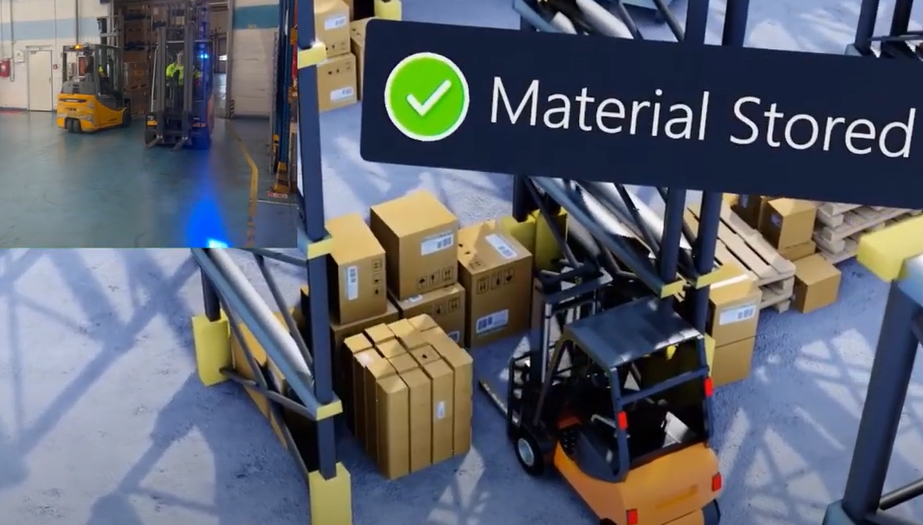
•  Best for: Forklift tracking, maintenance personnel, or tracking a limited number of objects.

•  Downside: Mobile devices require frequent charging (every 8-12 hours).

Active RTLS – High Precision & Scalability

Active topology is similar to WiFi, where antennas are installed to scan premises for tracking tags.

•  Common technologies: BLE, UWB, RFID.

•  Precision: Under 1 meter (as low as 20 cm for some technologies).

•  Best for: High-volume tracking (people, materials, safety-related use cases).

•  Downside: Installation can be complex due to power requirements.

Choosing the Right RTLS Technology

The most common RTLS technologies are RFID, BLE, UWB, and Camera Recognition. Each has unique advantages, and the best choice depends on your use case.

BLE – A Flexible RTLS Technology

BLE (Bluetooth Low Energy) is a highly flexible RTLS solution that can be deployed using different infrastructure models and localization techniques.

•  Passive BLE, which offers a precision range of 3 to 10 meters, requires a mobile device as the trackable component, making it particularly useful for forklift optimization.

•  Active BLE operates with basic BLE tags as trackables, maintaining the same precision while being better suited for tracking people, machinery, and materials. For higher accuracy,

•  AoA BLE (Angle of Arrival) technology enables precision below 1 meter, making it ideal for optimizing people and material flow within a facility. To support deployment, Twinzo and its partners provide starter kits and step-by-step installation guides for Passive BLE setups.

UWB – High Precision Tracking

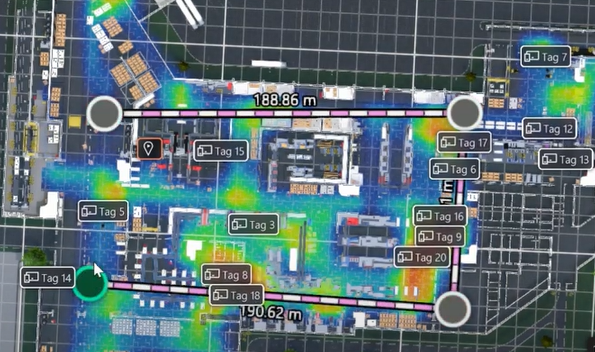
Ultra-Wideband (UWB) is a high-precision indoor localization technology.

•  Accuracy
: Up to 10 cm.

•  Best for: People & material tracking, process optimization, and collision avoidance.

•  Tag options: Badges, industrial tags, smartwatches, and more.

RFID – Cost-Effective Asset Tracking

RFID (Radio Frequency Identification) is a traditional and cost-effective asset tracking technology.

•  Best for: Large-scale tracking (hundreds or thousands of objects).

•  Advantages: No battery required (passive tags). Can be printed and used in low-cost applications.

•  Limitations: Limited range. Higher antenna costs.

You might also be interested in:

AOS as an integral part of Digital twin

AOS as an integral part of Digital twin

As supply chains get more complex and global, they become more volatile in times of disruption. Global pandemic disrupted the market both on the supply side and on delivery. This strain is exposing neglected shortcomings of external and internal logistics.

Logistics Analysis with Digital Twin

Logistics Analysis with Digital Twin

Where to start with digital twins in manufacturing? Well, we usually start with internal logistics. Why? Because there are enormous losses = the highest ROI! How is that? Logistics is often the last one in optimization! People think "they are just delivery boys"... 🙄 If logistics were so easy, armies wouldn't fail because of missing stuff - not just nowadays.

Landscape mode is not supported, please rotate your device.

By clicking “Accept”, you agree to the storing of cookies on your device to enhance site navigation, analyze site usage, and assist in our marketing efforts. View our Privacy Policy for more information.